
 Usman Salis

⬤ China's AI landscape went through a massive transformation in late 2025. Frost & Sullivan's enterprise report reveals that daily AI token consumption hit 37 trillion in H2, compared to just 10.19 trillion in H1 - that's a 263% surge in six months. What's really interesting is how open-source models flipped the market on its head, growing from 44% to 56% of total usage while closed-source systems lost ground. This shift reflects wider changes happening across Chinese industries, including practical robotics deployment like China Southern Power Grid testing Unitree G1 robots with advanced hybrid hands that combine smart perception with flexible task handling.
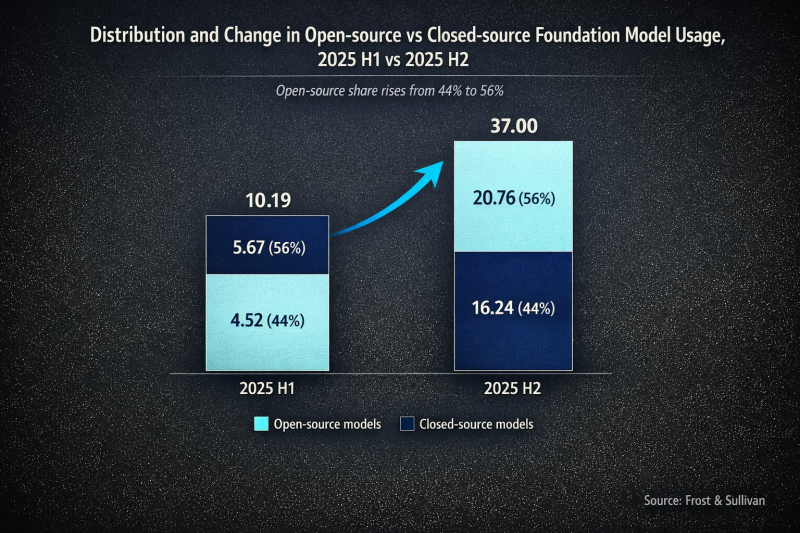
⬤ The vendor landscape changed dramatically too. The number of companies actively updating closed-source models dropped sharply, while open-source releases kept accelerating. Enterprises are clearly voting with their wallets - they prefer open ecosystems as they scale up deployment. Performance improvements in open-source models are backing up this trend. Take Minimax's M25 open-source model hitting an 802 Swebench score - these benchmarks show open-source isn't just about cost anymore, it's about capability.
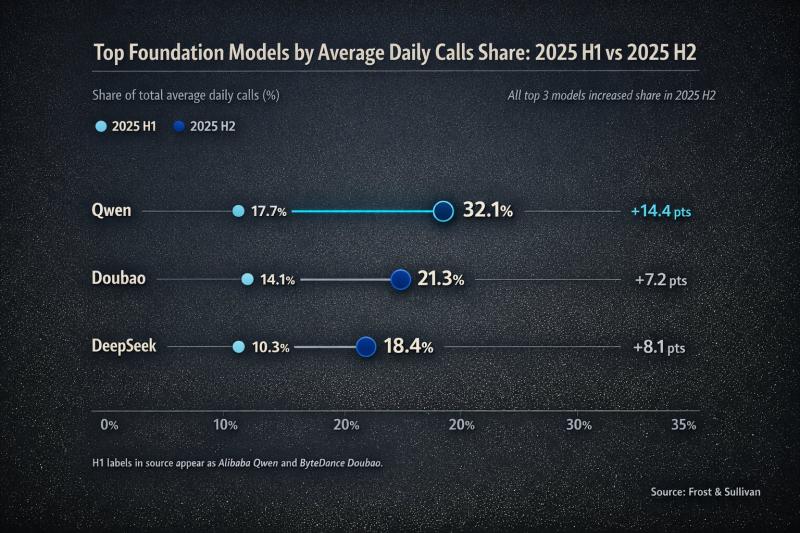
⬤ Three models pulled away from the pack in H2. Qwen nearly doubled its share from 17.7% to 32.1%, Doubao climbed from 14.1% to 21.3%, and DeepSeek jumped from 10.3% to 18.4%. Together they grabbed over 70% of all daily calls - up from under 50% in H1.
⬤ But it's not just about market share. How companies use AI changed too. Early on, most deployments handled simple, one-off queries. By H2, enterprises moved toward sophisticated autonomous workflows - systems that plan, execute tools, and iterate without constant human input.
⬤ China's enterprise AI market just entered a new growth phase. With most activity now running on flexible open-source platforms and adoption accelerating across industries, the momentum keeps building. This mirrors broader industrial automation trends - a recent survey shows 62% of Chinese companies plan humanoid robot deployment in coming years, signaling AI's expanding role beyond pure software applications.
 Usman Salis



