
 Usman Salis
OpenAI is making a significant move toward a unified AI platform - one that brings together ChatGPT, coding tools, web browsing, and agent-based functionality into a single cohesive experience. As Chris covered in his original report, the system is designed to understand what users actually want and then act on it across real workflows - not just answer questions in isolation.
The core idea behind the superapp is simple: stop making users juggle multiple tools. Instead of bouncing between a chatbot, a code editor, a browser extension, and an automation layer, everything lives inside one interface capable of handling a task from start to finish.
As models grow more advanced, usability becomes the primary challenge - shifting focus from raw intelligence to seamless interaction.
That shift matters because the biggest challenge in AI today isn't making models smarter - it's making them easier to use at scale.
Why the AI Superapp Is a Distribution Play, Not Just a Product Update
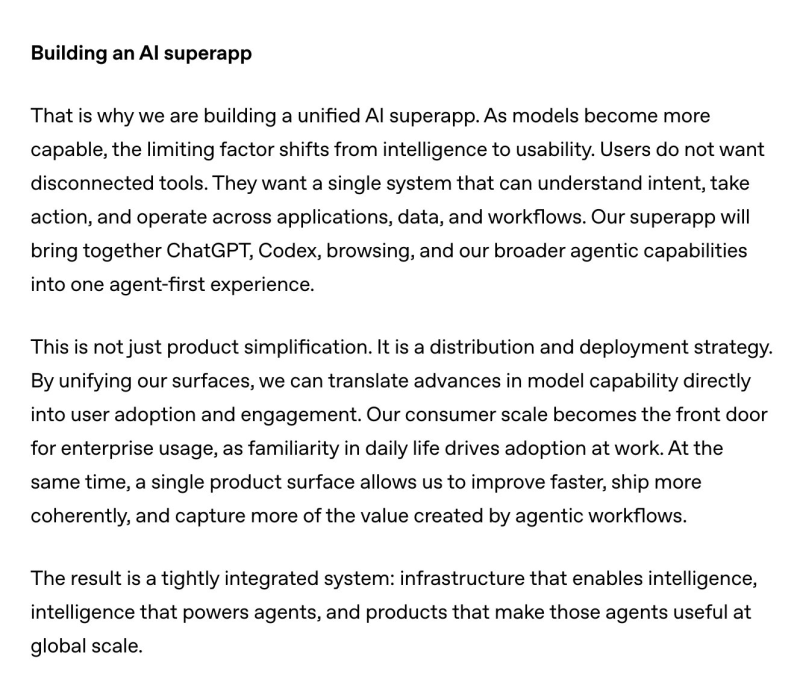
OpenAI isn't framing the superapp purely as a user experience improvement - it's a deployment and distribution strategy. By consolidating its platform, every improvement to the underlying model translates directly into better engagement across the board. There's no friction between model upgrades and the product users actually touch.
That strategic logic is backed by serious capital. The company has now raised $122 billion in funding, and the superapp represents where that investment is pointing - a merged stack that combines ChatGPT, Codex-powered coding assistance, native browsing, and autonomous agent capabilities under one roof.
Unifying the platform means improvements in underlying models can translate directly into higher user engagement and faster adoption.
Meanwhile, Anthropic's rapid enterprise client growth shows just how urgent it is for OpenAI to lock in its platform advantage before competitors do.
The AI Superapp Sits at the Center of a Broader Ecosystem Race
OpenAI's long-term vision follows a clear logic: infrastructure enables intelligence, intelligence powers agents, and products deploy those agents at scale. It's a vertically integrated AI stack - and the superapp is the consumer-facing expression of that structure.
OpenAI isn't alone in this direction. Several developments point to the same trend taking hold across the industry:
- Meta expands its AI stack with the Manus acquisition, reinforcing the push toward unified platforms
- Anthropic's enterprise client growth reflects intensifying competition at the deployment layer
- The surge in AI data center demand signals that infrastructure is being built out to match this integrated approach
The long-term vision is a tightly integrated AI stack - where infrastructure enables intelligence, intelligence powers agents, and products deploy those agents at scale.
Taken together, these shifts suggest the next major battleground in AI won't be which model scores highest on benchmarks - it will be which platform can actually deploy intelligence seamlessly, at scale, in a way users find natural to interact with. Analysts already project that AI data center demand will hit 219 GW by 2030 - a figure that underscores just how seriously the industry is betting on integrated AI deployment at scale. OpenAI's superapp strategy is an early and deliberate move to win that race.
 Usman Salis



