
 Victoria Bazir
Enterprise AI adoption just flipped. According to analyst Wes Roth, in a reversal that few predicted, Anthropic has overtaken OpenAI as the dominant player in first-time enterprise deployments, with new industry data showing a near-complete inversion of market positions in just two months. The shift underscores how quickly the generative AI landscape can move when performance in high-stakes workloads starts separating the field.
From 40% to 73%: Anthropic's Enterprise Surge Since December 2025
Back in mid-December 2025, OpenAI held a clear lead in new enterprise AI adoption, commanding 59.7% of first-time deployments against Anthropic's 40.3%. By late February 2026, those numbers had nearly inverted.
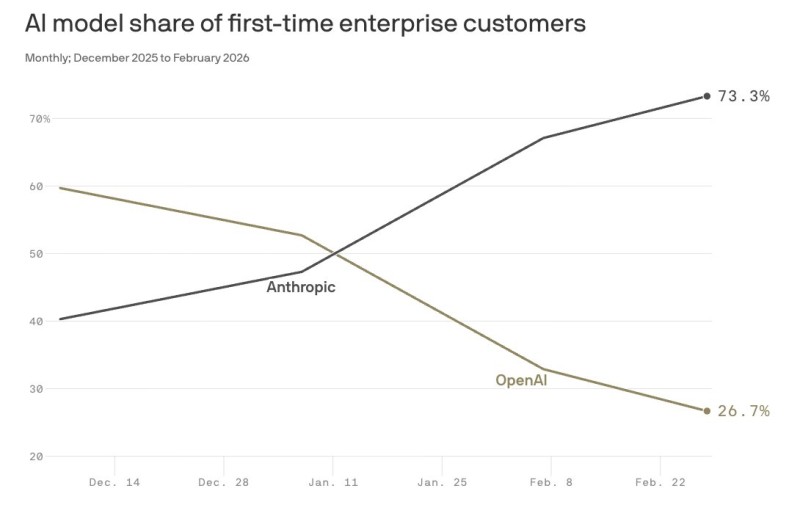
Anthropic climbed to 73.3% of new enterprise customers while OpenAI's share fell to 26.7% - a dramatic reversal in a remarkably short window. Recent reports from Menlo Ventures and Andreessen Horowitz confirm the trend, with both firms pointing to enterprise clients actively switching or expanding with Anthropic.
Coding and Reasoning Workloads Are Driving the Switch
The core driver behind this shift isn't general-purpose chat. It's specialized performance. Coding, reasoning, and data analysis workloads are where enterprise buyers are putting real money, and Anthropic's Claude model family has built a reputation for excelling in exactly these areas. Software engineering teams, in particular, have increasingly adopted Claude-based tools into their daily workflows. Anthropic has leaned into this positioning with developer tooling, API reliability, and safety-focused architecture that resonates with enterprise procurement teams.
The speed of this market shift suggests enterprise AI is entering a more performance-driven phase. Buyers are no longer choosing on brand recognition alone - they're running evals, comparing outputs, and switching when a model proves better at the tasks that actually matter. Anthropic's momentum in technical use cases positions it well for continued growth, though the generative AI market has already shown it can reverse course faster than anyone expects.
 Victoria Bazir



