
 Saad Ullah
Researchers from The Chinese University of Hong Kong, Kinetix AI, and Tsinghua University have introduced RISE - a new framework for robot learning built on imagination-driven reinforcement learning. As reported by 机器之心 JIQIZHIXIN, the system allows robots to self-improve by training entirely within a Compositional World Model, removing the need for costly physical-world interactions.
How RISE Replaces Physical-World Robot Training
Traditional physical-world reinforcement learning comes with serious limitations: high hardware costs, slow iteration cycles, and constant manual resets. RISE replaces this with a fully simulated learning environment. Within this model, robots predict future states and evaluate imagined outcomes to refine their decision-making policies. The result is continuous improvement through virtual rollouts - no repeated real-world trials required, while keeping learning effectiveness intact.
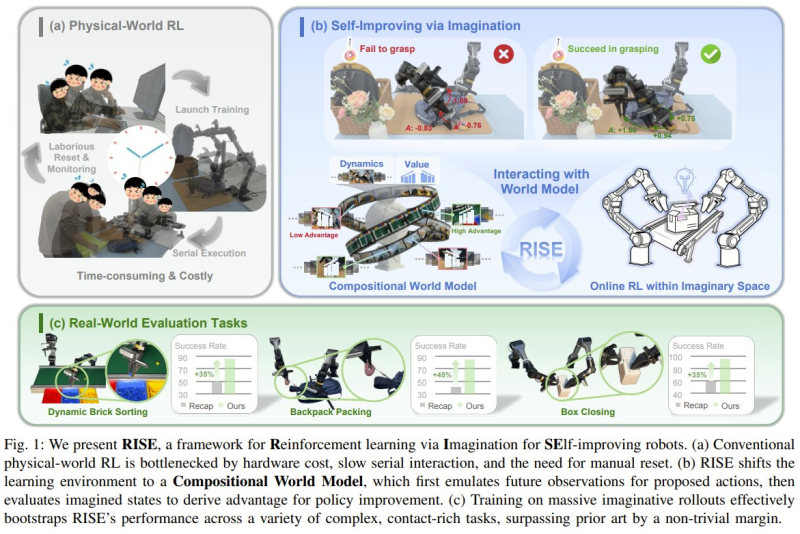
The framework's core innovation lies in how it structures simulation. Rather than relying on a single static model of the world, RISE uses a compositional world model architecture that allows robots to break down complex tasks into smaller, learnable components - making the training process both more efficient and more generalizable.
Using compositional world models to train robots in complex, contact-rich environments produces gains that no previous method has matched across multiple manipulation benchmarks.
This mirrors broader shifts in AI design, where agent engineering in AI systems is redefining how machines plan and act autonomously.
RISE Achieves Over 35% Improvement Across 3 Real-World Tasks
Experimental results show RISE significantly outperforms previous approaches across several real-world manipulation benchmarks. The performance improvements are consistent and substantial:
- Dynamic brick sorting - more than 35% improvement in success rate
- Backpack packing - around 45% improvement in success rate
- Box closing - over 35% improvement in success rate
These numbers confirm that imagination-based training is not just theoretically appealing - it delivers measurable results in tasks that involve complex, contact-rich physical interactions. Hardware innovation is keeping pace with these software advances, as demonstrated by Mirsee robotics humanoid advances, where Canadian engineers pushed autonomous robot operation to 10 hours on a single charge.
RISE and the Broader Shift Toward Simulation-Driven Robotics AI
The development of RISE reflects a wider momentum building across the robotics and AI space, where simulation-based training is becoming a primary driver of scalability. The competitive landscape is shifting fast too - Chinese AI leaders now estimate a 20% chance of catching OpenAI within 5 years, signaling just how quickly capabilities are advancing across the ecosystem.
As simulation-based training scales, demand for high-performance computing infrastructure is expected to grow alongside increasingly complex training workloads.
As these technologies scale, so does demand for the underlying hardware that powers them. High-performance computing platforms - including NVDA-driven infrastructure - are expected to see sustained growth as robot training workloads become more intensive and more widespread across industry.
 Saad Ullah



