
 Eseandre Mordi

OpenAI has introduced a new Codex Use Cases gallery designed to showcase practical development workflows inside its Codex environment. As Charly Wargnier reported, the feature allows users to browse a collection of tested coding and operations examples, with each use case opening a ready-to-run prompt directly in the Codex app.
The gallery focuses on simplifying how developers interact with AI-powered coding tools. Instead of starting from scratch, users can select a predefined workflow and instantly launch it within Codex. This approach aligns with how Codex is commonly used in practice - handling structured tasks like building features, fixing bugs, or generating code based on instructions. Some workflows, such as iOS app development, integrate tools like SwiftUI plugins to improve code structure.
Codex Workflow Categories Built Around Real Engineering Tasks
The interface emphasizes discoverability and ease of use.
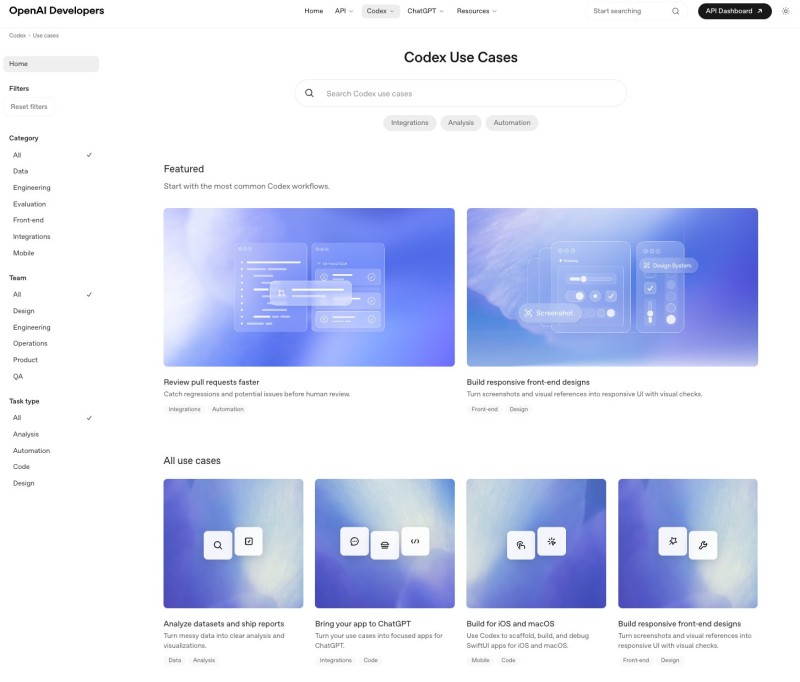
It organizes workflows into categories like integrations, analysis, and automation, enabling developers to quickly find relevant examples. Featured use cases include:
- Reviewing pull requests faster
- Building responsive front-end designs
- iOS app development with SwiftUI plugin integration
- Automation workflows with minimal setup
Codex Use Cases Signal a Broader Shift in AI-Powered Development
This release reflects a broader shift in how AI tools are being embedded into development workflows. By turning proven use cases into instantly deployable prompts, OpenAI is moving toward a more standardized and accessible model of software development, where common engineering patterns can be reused and executed with minimal setup.
Common engineering patterns can be reused and executed with minimal setup - a shift that points to a more template-driven future for AI-assisted coding.
The move also connects to OpenAI's broader $1.4T push toward autonomous AI systems, which increasingly targets developer productivity as a core use case. The Codex gallery represents one practical step toward that vision - reducing the friction between a developer's intent and a working, deployable result.
 Eseandre Mordi



