
 Usman Salis

AI is making measurable gains in marketing efficiency, according to data shared by Neil Patel. Based on a survey of 300 marketers, AI does not eliminate all steps in content marketing - but it makes the process approximately 37.5% more efficient by removing the redundant parts that slow teams down.
How AI Reduces Content Workflow From 8 Steps to 5
The data shows that traditional content workflows typically involve eight steps. With AI integration, marketers are able to eliminate three of those steps on average, reducing the process to roughly five. The accompanying chart reflects this shift clearly, highlighting a measurable drop in workflow complexity between traditional and AI-assisted production.
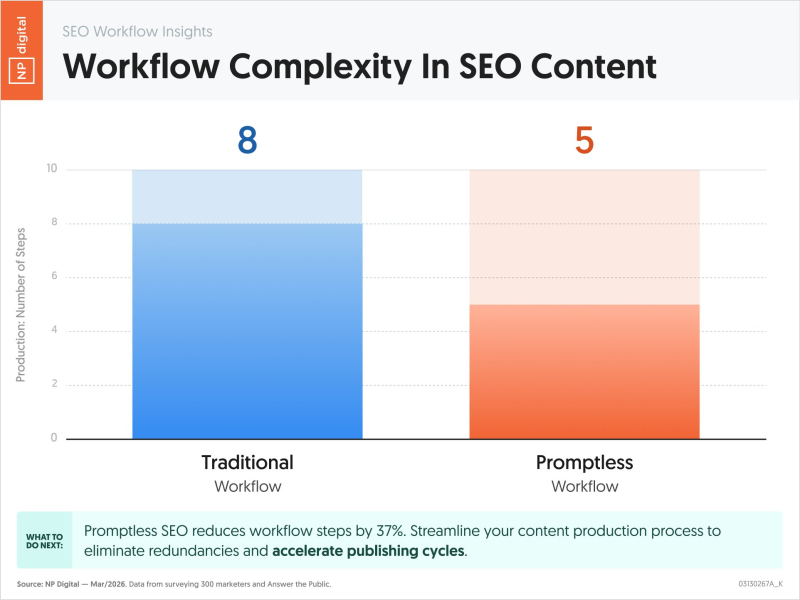
This improvement is driven by the removal of redundant or repetitive tasks rather than a full replacement of human input. AI tools streamline execution, allowing teams to move faster through production cycles while still maintaining the core stages of content creation.
AI Efficiency Gains Align With Broader Content Discovery Shifts
The findings align with broader industry trends, where AI is reshaping not just how content is produced but how it is discovered and delivered online. Recent research shows that AI-driven search and content systems are changing visibility dynamics - fewer clicks go to traditional links, and more value is placed on being included in AI-generated answers.
GOOGL SEO Shift: AI Discovery Is Quietly Reshaping Traffic Strategy explored exactly this transition, showing how the distribution of discovery across platforms is forcing content teams to rethink both production speed and visibility strategy at the same time.
As competition for attention evolves, efficiency in content production is no longer just a nice-to-have - it is becoming a structural advantage.
AI Search Visibility Becomes New SEO Battleground reinforces that point, showing how brands that move faster through production cycles are better positioned to compete for inclusion in AI-generated responses - a channel that is becoming increasingly central to how audiences find content online.
 Usman Salis



