
 Peter Smith
⬤OpenAI is making a decisive move beyond conversational AI, developing multi-agent systems capable of running independent research end-to-end. Chief Scientist Jakub Pachocki has called this the company's defining long-term challenge - building systems that can plan, execute, and iterate on complex tasks without continuous human oversight.
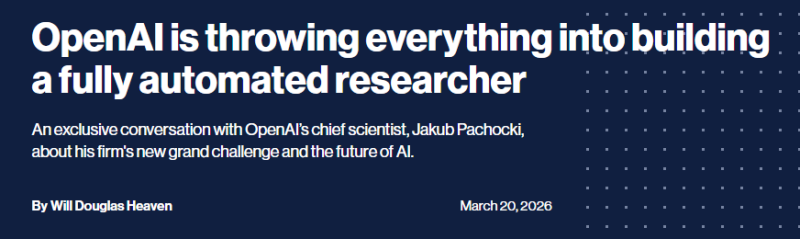
⬤The roadmap is concrete: an "autonomous AI research intern" by September 2026, followed by a fully independent "AI researcher" by March 2028. These systems will build on tools like the Codex coding agent, with the core assumption that AI capable of multi-step engineering problems can extend that logic to scientific discovery across text, code, and data.
⬤Underpinning this vision is a staggering infrastructure bet: roughly 30 gigawatts of compute capacity at an estimated cost of $1.4 trillion. This scale reflects how deeply hardware ecosystems now drive AI competition. As seen in the Google and OpenAI lead AI image race with 60 models ranked, rapid model iteration is already pushing compute demand to new limits.
⬤The implications reach well beyond software. The shift from assistive tools to autonomous agents changes how research and development get done. Benchmarks are emerging as a key battleground, as demonstrated by OpenAI GPT-5.4 Mini hitting 72.1% on OSWorld benchmark. Compute scale, model efficiency, and system reliability are now strategic assets - not just technical specs.
 Peter Smith



