
 Eseandre Mordi

⬤ Here's the thing: a new research model called LongVie 2 just showed up and it's turning heads. This AI can generate ultra-long videos—we're talking three to five minutes—starting from just one image. What makes it special? The videos actually stay coherent the whole way through. No weird jumps, no visual breakdowns. The researchers are calling it a controllable video world model that builds long-form content step by step instead of stitching together random short clips.
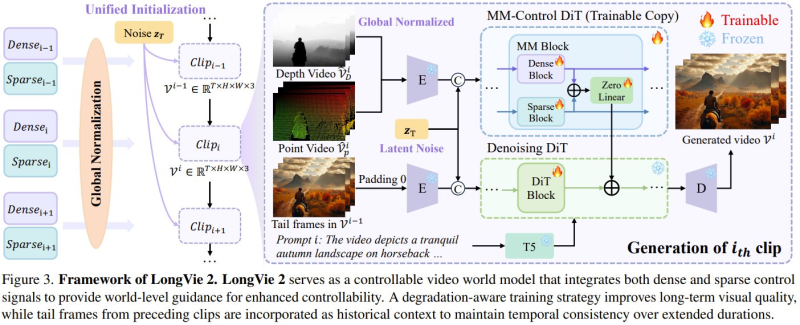
⬤ The way LongVie 2 works is pretty clever. It uses both dense and sparse control signals to guide the video generation process. Think text prompts, sketches, and visual context pulled from earlier parts of the video. The system has a unified initialization process and global normalization that keeps everything stable over time. Plus, it reuses the final frames from previous segments as historical context, which is how it maintains that temporal coherence throughout those long sequences.
⬤ Most earlier video generation models hit a wall when you try to extend them. They start flickering, losing visual quality, or just drift off into nonsense as the clip gets longer. LongVie 2 tackles this head-on. The architecture splits trainable and frozen components within its denoising diffusion transformer, letting the system stay consistent while still responding to new inputs. The research paper shows measurable improvements in controllability, visual quality, and temporal stability—especially for these ultra-long generation tasks.

⬤ Why does this matter? Because controllable long-form video generation opens up entirely new possibilities for generative AI. When you can maintain coherent scenes for minutes instead of seconds, you're suddenly looking at practical applications in simulation, virtual environments, content creation, and embodied AI research. Models like LongVie 2 represent a real shift toward systems that can model long-horizon visual dynamics with actual stability and control. That's the next frontier for AI video
 Eseandre Mordi



