
 Victoria Bazir
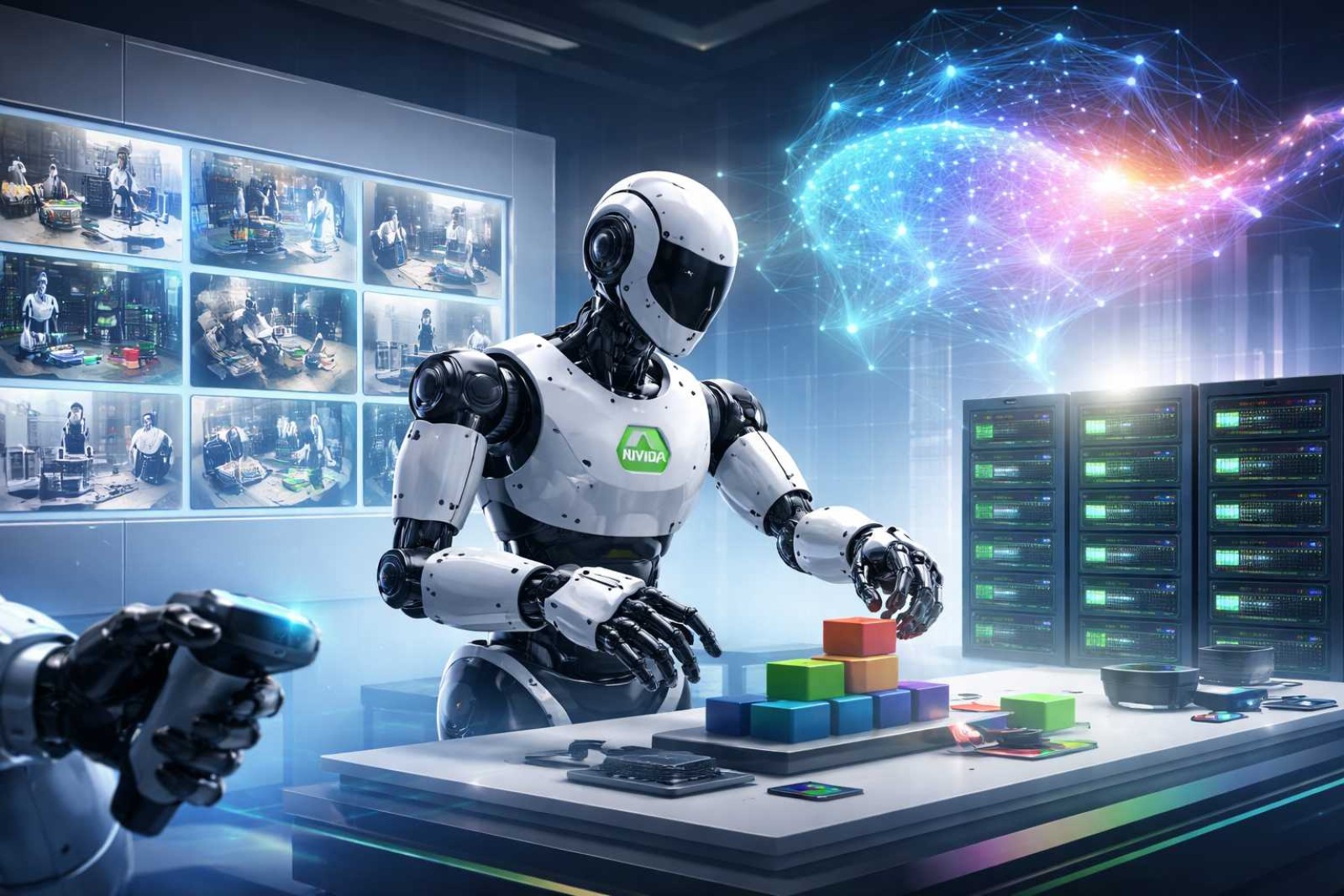
⬤ NVIDIA Corporation just introduced EgoScale, a foundation model built to make humanoid robot teleoperation far cheaper and more scalable. The system is pretrained on thousands of hours of egocentric human video, mid-trained on a mix of human and robot "play" data, then fine-tuned on a handful of task-specific examples. The result is a human-robot alignment pipeline that cuts the traditional data overhead that has kept teleoperated humanoids out of practical deployment. This fits squarely into NVIDIA's broader vision of humanoid robots becoming the largest electronics market.
⬤ The training pipeline is where EgoScale really earns its name. It starts with a large pretrained model absorbing naturalistic human movement from egocentric video, then bridges the gap between human and robotic embodiments using roughly 50 hours of combined data and just 4 hours of robot interaction. From there, fine-tuning requires fewer than 100 demonstrations per task. The system has shown strong results transferring learned capabilities across different robot hand configurations, including five-fingered Sharpa systems and three-fingered Unitree G1 hands - a solid signal for cross-platform generalization. On the hardware side, NVDA GPU breakthroughs have already cut video generation time from 184 seconds to just 19, showing the same drive toward doing more with less.
⬤ This positions NVDA squarely at the intersection of robotics, AI, and foundation models - well beyond its GPU roots. The pattern holds across the broader ecosystem too, where AI systems are now cutting complex coding tasks by 99%, pointing to a wave of efficiency gains that spans hardware and software alike.
⬤ EgoScale signals that NVIDIA isn't just building the picks and shovels for the AI era - it's actively shaping the applications layer. By lowering the barrier to scalable teleoperation, the technology could accelerate adoption of autonomous and semi-autonomous robots across industrial, service, and research settings, adding another dimension to NVIDIA's expanding role in the AI-powered economy.
 Victoria Bazir



