
 Sergey Diakov

⬤ Goldman Sachs just rolled out a monthly "AI adoption tracker" to keep tabs on where AI investment dollars are flowing and how it's affecting markets and jobs. The tracker's showing something pretty clear: companies are still pouring serious money into AI infrastructure, and chip makers are cashing in big time as demand for computing power keeps climbing across every industry.
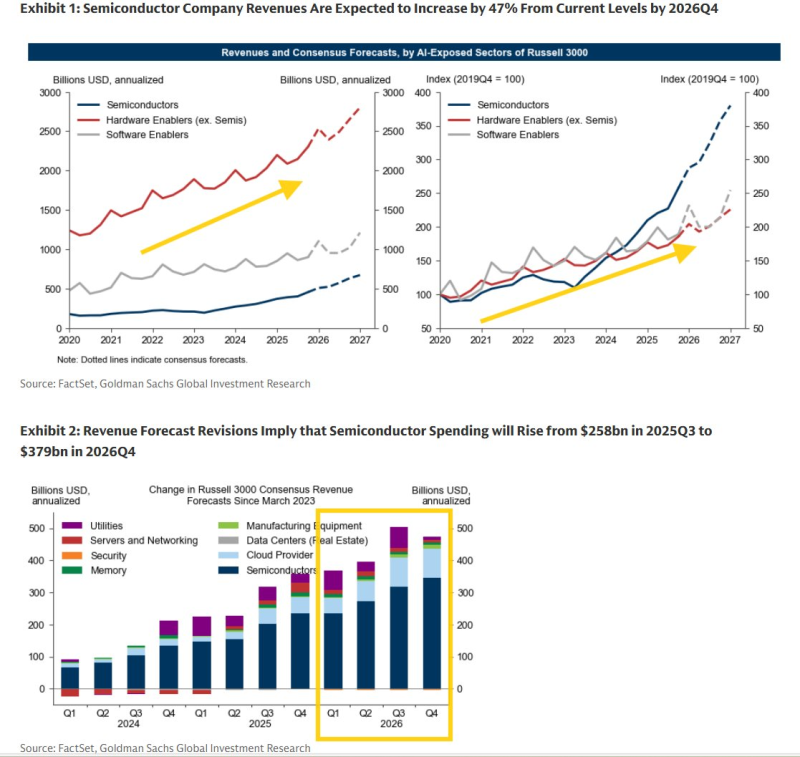
⬤ Goldman's numbers show equity analysts are betting on semiconductor revenues jumping 47% from where they are now through the end of 2026—one of the biggest growth runs the tech sector's seen in years. Their charts lay out steep climbs in revenue forecasts for chips, hardware, and software through 2025 and 2026. What's driving it? Massive buildouts in AI training systems, inference workloads, and data centers that need way more processing muscle than anything we've seen before.
⬤ Here's where it gets interesting: spending forecasts just got revised way up. The tracker shows semiconductor spending climbing from $258 billion in 2025Q3 to $379 billion by 2026Q4. Chips are grabbing the biggest slice of that growth, followed by memory, manufacturing equipment, servers, networking gear, and cloud infrastructure. These aren't small adjustments—they're showing how AI workloads are completely reshaping supply chains and where tech companies are putting their capital.

⬤ What Goldman's tracker is really capturing is the shift from "let's test AI" to "let's scale this thing up." Companies aren't just experimenting anymore—they're building out full production systems. The money flooding into accelerators, memory systems, and supporting hardware proves semiconductors aren't just part of the AI story—they're the foundation everything else gets built on. Goldman's updated numbers make it crystal clear: the tech world's moving fast toward AI-driven computing, and the hardware needed to power it is where the smart money's heading.
 Sergey Diakov



