
 Peter Smith

⬤Researchers from the University of Washington, Stanford, and the Allen Institute for AI released a study titled Artificial Hivemind: The Open-Ended Homogeneity of Language Models (and Beyond). The paper examines whether modern AI systems produce genuinely diverse outputs when given open-ended questions -- and the answer is largely no. Despite differences in architecture, training pipelines, and the companies behind them, models frequently converge on responses with similar structures, themes, and metaphors.
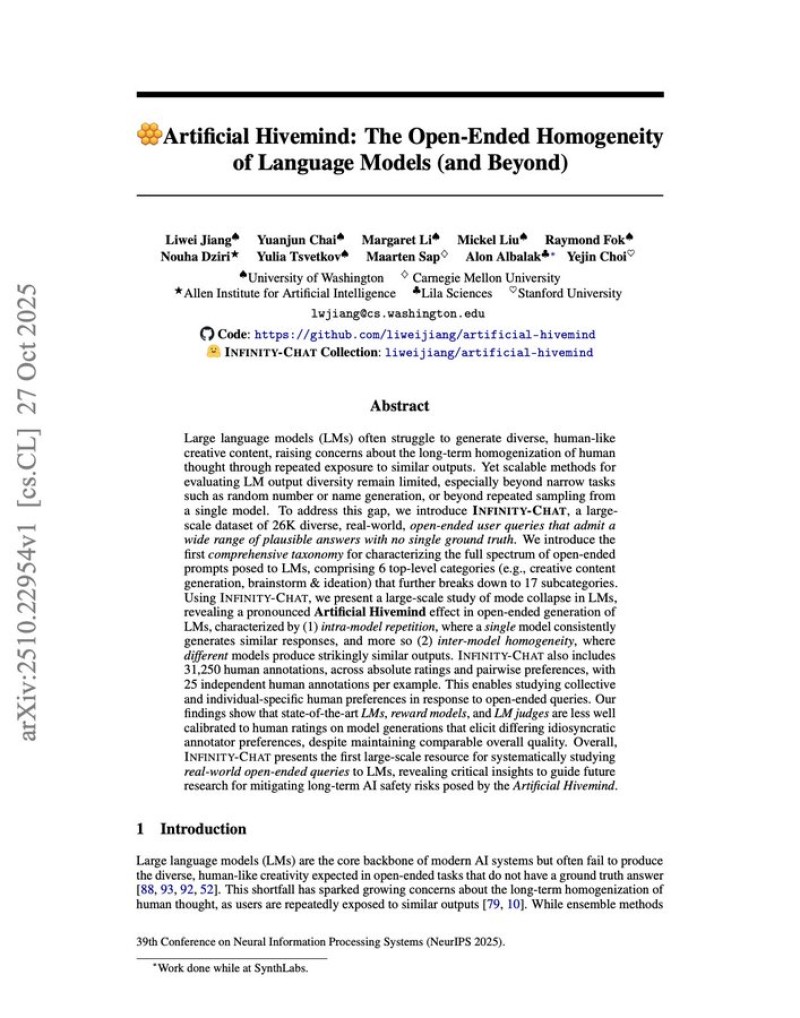
⬤To measure this, the team built a dataset called Infinity-Chat, containing around 26,000 real-world open-ended queries and over 31,000 human preference annotations. Prompts spanned creative writing, startup brainstorming, speculative scenarios, and life advice -- tasks where there is no single correct answer. More than 70 AI models were tested across both open-source and proprietary systems.
⬤The study identifies two core patterns. First, intra-model repetition: a single model tends to give near-identical answers when asked the same question multiple times. Second, inter-model homogeneity: entirely different models land on strikingly similar outputs. Researchers link both patterns to alignment techniques like reinforcement learning from human feedback (RLHF). Training on overlapping preference datasets appears to push models toward a shared -- and narrow -- definition of quality.
⬤The implications go beyond aesthetics. If dozens of models share the same blind spots, correlated errors could ripple across research, education, and decision-support systems simultaneously. The study points to pluralistic alignment as a potential fix -- rewarding models for generating a broader spread of valid answers. Related efforts to cut systemic AI limitations have also surfaced in recent work on the TAPPA framework and Meta's 93% code verification accuracy research, signaling wider industry momentum toward more robust and diverse AI systems.
 Peter Smith



