
 Marina Lyubimova

Building a retrieval-augmented generation pipeline used to take days of configuration work. Langflow just changed that with OpenRAG, an open-source platform that collapses the entire RAG stack into a single deployable environment, launchable with one command: uvx openrag.
1 Command, Full RAG Stack: What OpenRAG Actually Ships
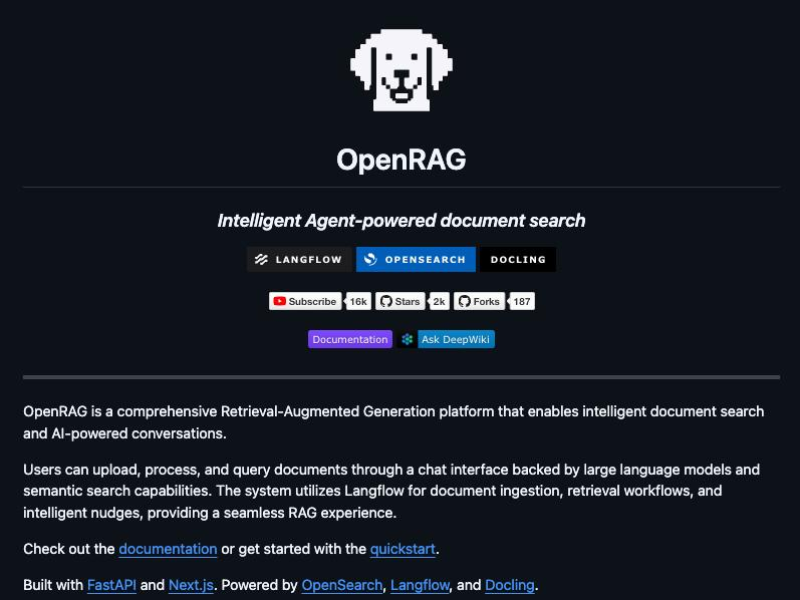
OpenRAG bundles everything developers previously had to wire together manually. The platform integrates Langflow visual workflows, OpenSearch for semantic retrieval, and Docling for document processing, built on a FastAPI and Next.js foundation. Upload documents, run retrieval, and chat with your data through a conversational interface, all within a unified framework.
Building a RAG pipeline previously could take days or even weeks of configuration work.
The system targets one of the most time-consuming parts of building AI applications. Where assembling vector databases, document processors, and LLM interfaces once required weeks of setup, OpenRAG compresses that into minutes. Developers get document ingestion, semantic search, visual workflow editing, and Docker deployment out of the box.
Why Simplified RAG Infrastructure Matters Right Now
The release lands as organizations are rethinking how they deploy AI for enterprise search and knowledge management. The broader AI Memory Evolution bringing 10x efficiency gains as RAG systems evolve shows that retrieval architecture is still a fast-moving target, not a solved problem.
At the same time, developers are choosing between increasingly specialized approaches. Research into 10 specialized RAG types transforming AI systems reflects how fragmented the space has become, making all-in-one tools like OpenRAG more appealing for teams that want to ship rather than architect. Frameworks like the new AI decision framework for Long-Context, RAG, or 3-Step Agents further underscore that the right retrieval strategy depends heavily on use case, not just tooling.
OpenRAG does not try to solve every retrieval problem. What it does is remove the infrastructure barrier for the most common one: letting developers build intelligent document search and conversational knowledge systems without spending the first week just connecting services. For teams that need a working AI search environment fast, that is a meaningful shift.
 Marina Lyubimova



