
 Eseandre Mordi
Artificial intelligence is no longer waiting in research labs before entering hospitals. A joint team from Stanford and Princeton has deployed MedOS, a clinical AI platform that combines multi-agent reasoning, extended reality smart glasses, and robotic assistance into active hospital workflows at Stanford Medicine.
MedOS Tops MedQA and GPQA, Outperforming Major AI Models
Benchmark results show MedOS achieving state-of-the-art scores on MedQA and GPQA, two leading evaluations for medical reasoning.
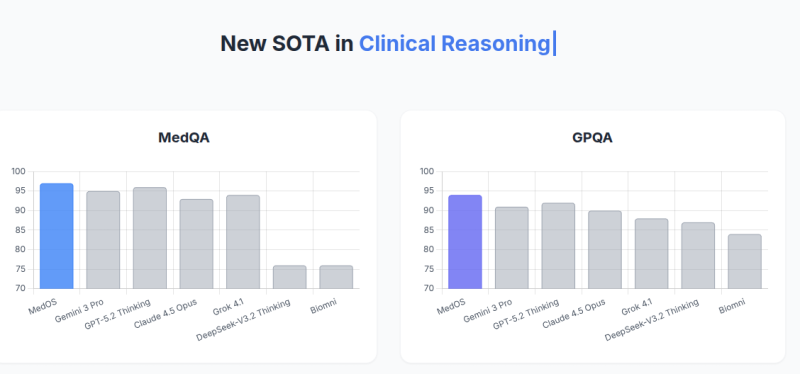
The system outperforms Gemini 3 Pro, GPT-5.2 Thinking, Claude 4.5 Opus, Grok 4.1, and DeepSeek-V3.2 Thinking. These benchmarks test an AI's ability to handle complex clinical problem-solving, not just pattern recognition on curated datasets.
The AI observes what clinicians see through wearable smart glasses and responds in near real time.
Deployment is already underway at the Stanford Blood Center and the Stanford Department of Pathology, making MedOS one of the first systems of its kind to leave controlled testing and enter real medical operations.
XR Smart Glasses and Robotic Arms Bring AI Into Physical Procedures
What separates MedOS from screen-based clinical tools is its physical integration. Doctors wear XR smart glasses that stream their point of view to the system, while collaborative robotic arms assist with delicate tasks including suturing, knot tying, and instrument handling. Recent latency improvements have pushed the system toward near real-time response during live procedures. This approach follows the same trajectory as AI systems generating $10,000 in 7 hours through real work tasks, where autonomous AI moved beyond theory into operational performance.
The MedOS rollout also connects to wider momentum across AI-driven scientific discovery. Large language models have already shown practical value in biomedical contexts, such as when GPT-5 Pro identified an existing drug for a rare food allergy matching a real clinical study. Advances in AI reasoning are accelerating across disciplines as well, seen in how Meta AI code reasoning hit 93% verification accuracy without running a single line.
The MedOS deployment signals a turning point. As AI systems gain stronger reasoning, lower latency, and physical interaction capabilities, the technology is moving from analytical support toward active participation in critical professional environments.
 Eseandre Mordi



