
 Saad Ullah

⬤ A fresh open-source AI memory framework called MemU is shaking up how agents handle memory by ditching vector databases entirely. Instead of complex embedding pipelines, MemU uses a file-system design that lets AI agents read memory files directly—basically the same way you'd review your own written notes.
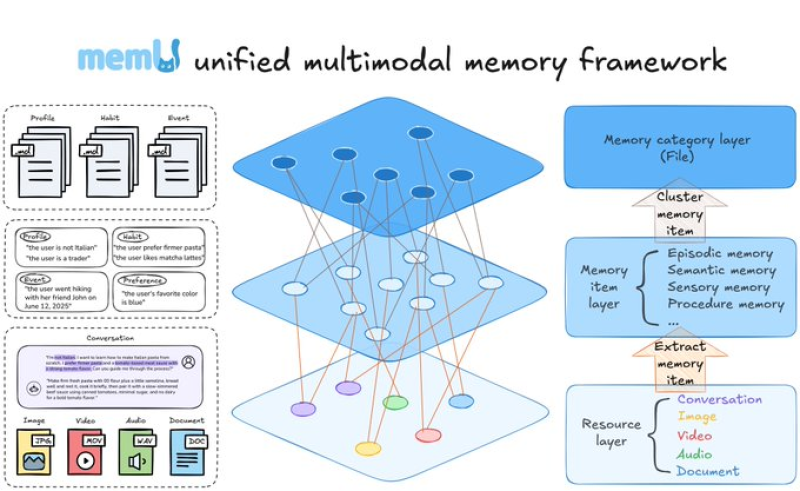
⬤ MemU keeps everything in plain Markdown files instead of hidden vector indexes. These files get organized into clear memory categories and items, so agents can pull out and group information without depending on embeddings alone. The framework offers dual-mode retrieval that mixes LLM reasoning with regular search methods, making stored memory way more transparent and accessible.
⬤ The framework handles images, audio, video, and documents as equal memory resources—not as afterthoughts. All these data types live and get recalled within the same memory system. Plus, MemU gives developers full control over prompts, so they can customize exactly how agents read and use stored memory.
⬤ MemU's release signals a growing push toward simpler, more transparent AI infrastructure as agent-based systems spread. With human-readable memory files and open-source code, the framework makes AI systems easier to check, adjust, and build on as multimodal reasoning keeps advancing.
 Saad Ullah



