Victoria Bazir
⬤ The Forecasting Research Institute dropped fresh findings from the Longitudinal Expert AI Panel, a three-year project tracking expert predictions on AI capabilities and real-world impact. Experts are putting 23% odds on rapid AI progress hitting by 2030—think AI outperforming humans in software engineering and independently cracking major medical problems like cancer treatment breakthroughs.
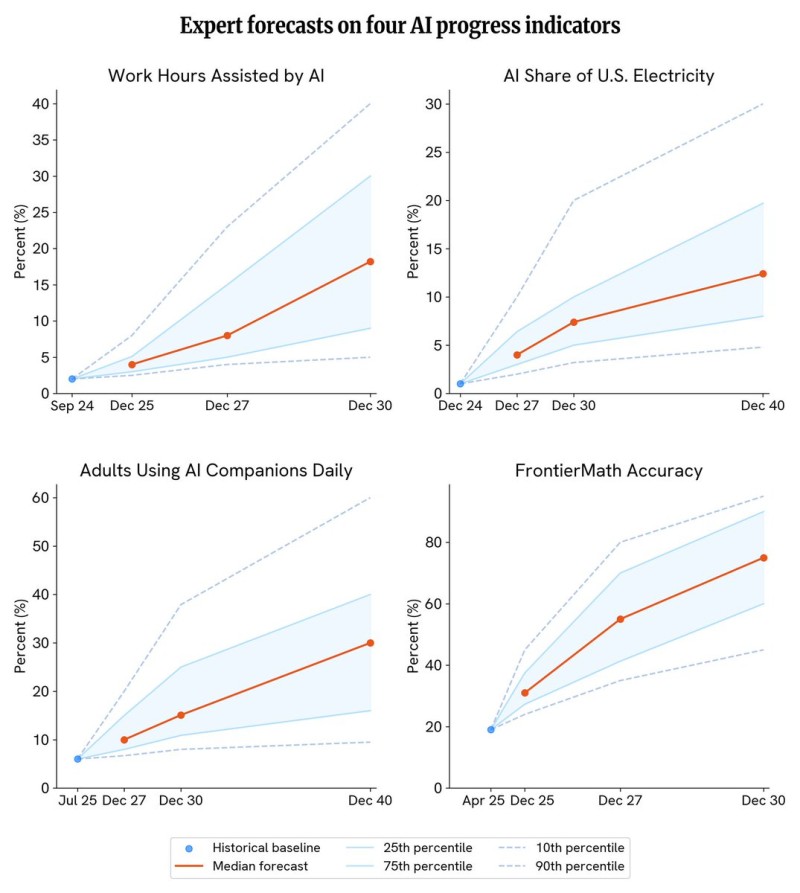
⬤ The numbers tell a compelling story: AI's expected to handle 18% of U.S. work hours by 2030, jumping from today's 4.1% baseline. Energy demand's another big piece—AI's slice of U.S. electricity usage could surge from 1% now to 7% by 2030 and 12% by 2040. On the consumer side, 15% of adults might be using AI companions by 2030, climbing to 30% by 2040. Transportation and research are seeing shifts too: 20% of rideshare trips could go autonomous by 2030, while 30% of scientific papers in physics, materials science and medicine may involve AI engagement, up from 3% today. And 23% of experts think the FrontierMath benchmark gets solved by 2030.
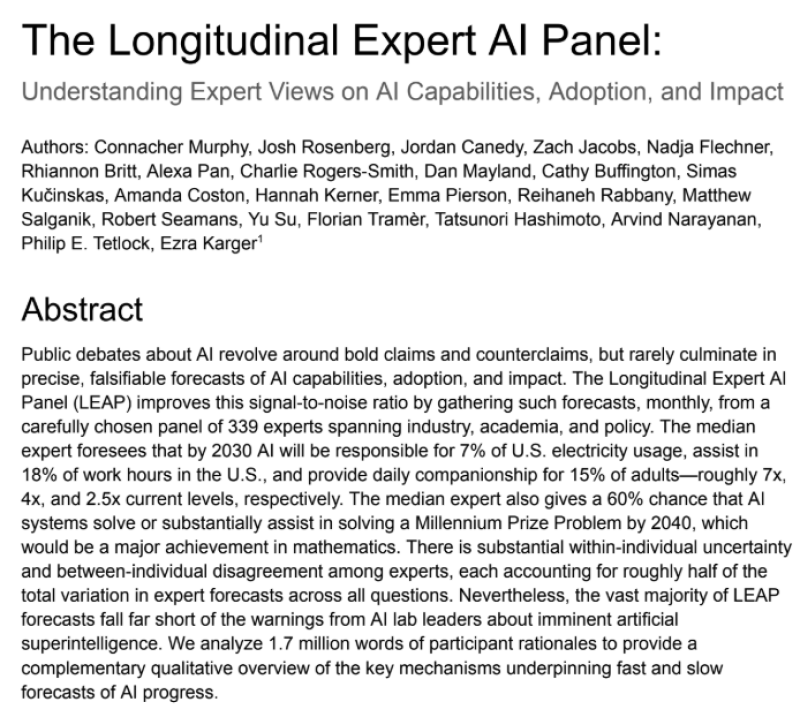
⬤ Investment forecasts are equally striking. Private AI funding's projected to hit $260 billion by 2030, double the $130 billion in 2024. Experts assign 60% odds that AI solves or significantly helps crack a Millennium Prize Problem by 2040, with 20% probability by 2030. The panel sees 32% chance AI becomes a millennium-defining technology by 2040 and 63% probability it achieves at least century-level impact. What's fascinating: 51% of forecast variance comes from disagreements among experts themselves, showing just how divided views are on AI's trajectory.
⬤ These projections map out quantified scenarios for AI's effects on labor markets, energy infrastructure, scientific output and everyday consumer behavior. The LEAP forecasts give us a structured lens for tracking how expert expectations might drive technology adoption, market sentiment and economic shifts across multiple sectors through 2030 and beyond.
 Victoria Bazir