
 Eseandre Mordi
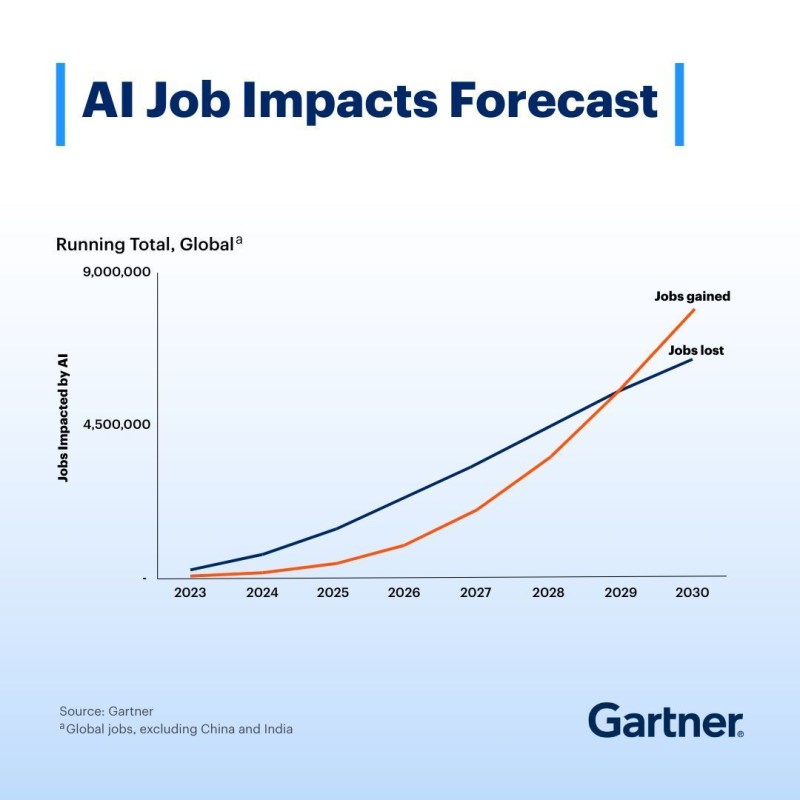
The fear that artificial intelligence will wipe out jobs on a massive scale has dominated headlines for years. But the latest forecast from Gartner tells a more nuanced story: AI won't cause a jobs apocalypse - it will cause job chaos. According to the firm's AI Job Impacts Forecast, both job losses and job creation will rise steadily through 2030, with AI ultimately generating more employment than it eliminates by around 2028-2029.
The research tracks how rapidly organizations are restructuring roles and workflows around AI technologies. While some displacement is inevitable in the near term, Gartner analysts argue that the net employment effect will turn positive well before the end of the decade.
32 Million Jobs a Year Will Be Transformed, Not Deleted
One of the most striking figures in the report is scale: Gartner estimates more than 32 million jobs globally could be significantly reshaped every year as AI tools change how tasks are performed. This transformation spans industries from technology and finance to customer service and administration.
The pattern emerging is not mass deletion of roles but deep redefinition of them - workers increasingly collaborating with intelligent systems rather than being replaced by them.
There will be no jobs apocalypse - but there will be a period of job chaos as organizations restructure roles and workflows around AI.
The momentum behind this shift is already visible. AI-related job growth accelerating after the launch of large language models shows how quickly the labor market has started adapting to new AI capabilities, with roles most exposed to language models growing at a striking pace since ChatGPT's debut.
New AI Capabilities Are Expanding the Range of Work Available
The forecast also points to a technology pipeline that will continue to generate new categories of work. Across the AI ecosystem, next-generation AI reasoning systems delivering major performance improvements are expanding what businesses can automate - while simultaneously creating demand for new specialized skills to build, manage, and audit these systems.
At the same time, the rise of AI agents capable of running long multi-step workflows autonomously illustrates how fast the nature of work is evolving. These autonomous tools don't just replace individual tasks - they reshape entire job functions, requiring workers to develop higher-order skills in oversight, strategy, and collaboration with AI systems.
The broader message from Gartner's research is clear: the organizations and workers that adapt proactively to AI's transformation of the workplace are far better positioned than those waiting to see how the disruption lands. The crossover to net job creation is coming - the question is whether today's workforce will be ready for the roles that arrive with it.
 Eseandre Mordi



