
 Eseandre Mordi

When ChatGPT launched in late 2022, many predicted that the jobs most exposed to AI would be the first to disappear. Three years of employment data suggest something very different is happening.
The Data Nobody Expected
Research combining AI exposure scores from Felten et al. (2023) with Bureau of Labor Statistics data from 2014 through 2024 tracks five groups of occupations ranked by their exposure to AI language tools.
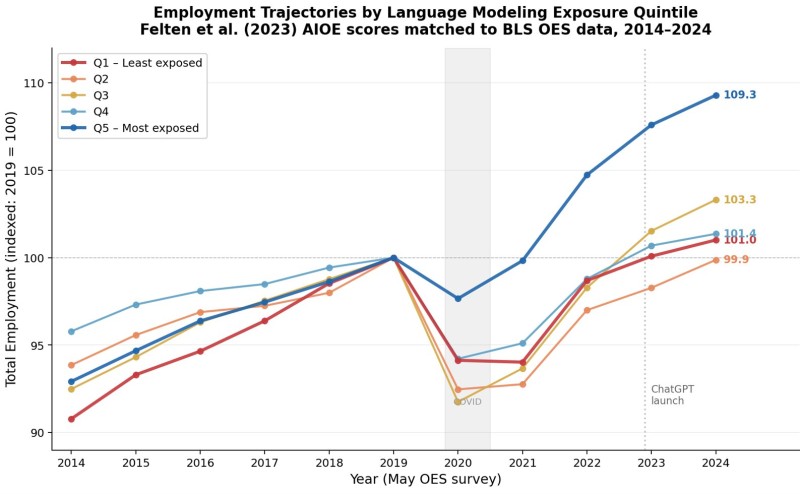
By 2024, the most-exposed group hit an indexed employment level of 109.3 against a 2019 baseline of 100. The least-exposed group reached just 101.0. That's a meaningful gap, and it's been widening since ChatGPT went mainstream.
What the Employment Divergence Actually Means
All five groups took a hit in 2020 during COVID disruptions, and the recovery was fairly even at first. But after 2022, the trajectories started pulling apart. The middle groups landed somewhere in between, with the third quintile reaching 103.3 and the fourth at 101.4, while the second dipped slightly below baseline at 99.9. The split is hard to ignore.
This challenges the assumption that AI exposure is simply a risk factor. Instead, it looks more like a demand signal. Sectors where language models are most relevant appear to be generating new roles rather than shrinking. Part of that story connects to how AI discourse shapes public debate, keeping these tools at the center of business and hiring conversations. Meanwhile, global AI adoption momentum spreading across major economies has amplified demand for workers who can operate alongside these systems.
Commercial enthusiasm around AI has been enormous too. The surge in ChatGPT interest reflected in strong ad search activity - around 55,000 daily searches related to ChatGPT ads alone - shows just how deeply these tools have embedded themselves in both consumer behavior and business planning.
None of this means displacement isn't coming. The current data covers only a few years, and labor markets adapt slowly. But for now, the evidence suggests AI integration is expanding the pie in high-exposure fields more than it's shrinking it - a meaningful finding for anyone thinking about workforce development, skill investment, or where hiring demand is actually heading.
 Eseandre Mordi



