
 Eseandre Mordi

⬤ Enterprise AI spending kept climbing through 2025, with generative AI now taking up roughly 6% of all U.S. software budgets. The numbers show spending reached $37 billion, growing about 3.2x year over year. Large American companies are moving beyond testing and actually using these tools to get work done faster. Early adopters are reporting solid productivity improvements, which is pushing more businesses to commit real money to AI infrastructure.
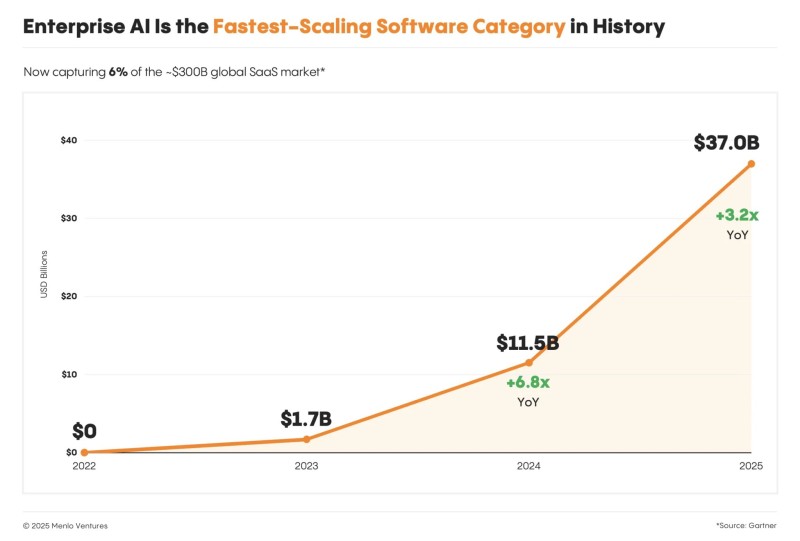
⬤ The growth pattern tells the story clearly: spending went from almost nothing in 2022 to $1.7 billion in 2023, then shot up to $11.5 billion in 2024, and now stands at $37 billion in 2025. Those year-over-year jumps of 6.8x and 3.2x make this one of the fastest-growing software categories we've ever seen. The pace matches what the big AI companies are reporting in their own numbers, showing that demand across the market is genuinely accelerating.
⬤ Companies are putting generative AI to work in practical ways—automating routine tasks, analyzing data, handling customer questions, searching internal documents, and helping developers write code. Survey data from about 500 enterprise executives shows that budgets have shifted from "let's try this" to "we need this." AI is moving from the innovation sandbox into the core operations budget.

⬤ This kind of rapid scaling is reshaping how software companies compete and how businesses plan their tech spending. If growth holds anywhere near this pace, we'll likely see AI become the default layer in most enterprise software within a few years. With adoption spreading and results getting easier to measure, generative AI looks set to be a major force in corporate digital strategy for the foreseeable future.
 Eseandre Mordi



