
 Eseandre Mordi

Generative search is rewriting the rules of online visibility, and a new framework from Carnegie Mellon University and Vody wants to help publishers keep up. AutoGEO is built to automatically learn how AI-powered search engines rank and surface content, then rewrite that content accordingly. The broader AI landscape is already moving fast - researchers recently showed that an AI system can screen 10 trillion drug-protein combinations in 24 hours, a sign of just how quickly the technology is scaling across industries.
How AutoGEO's Dual-Model Pipeline Learns AI Search Preferences
At its core, AutoGEO runs a structured pipeline that extracts preference rules directly from large language models. It analyzes how different documents perform inside AI-generated answers, captures the visibility patterns behind that performance, and uses those insights to rewrite content more strategically.
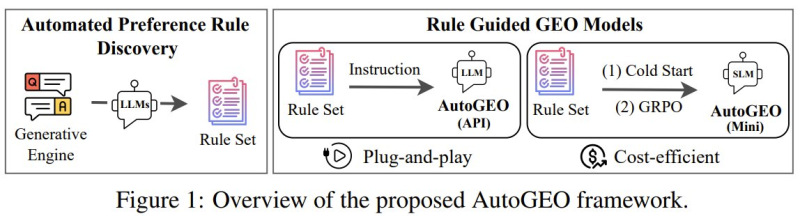
The system ships in two versions: a plug-and-play API model powered by large language models, and a leaner, cost-efficient variant trained with reinforcement learning. That dual approach makes it both scalable for enterprise use and practical for smaller content operations. The competitive stakes are real DeepSeek V4 Lite recently scored 2nd place among all Chinese AI models in the latest rankings, underscoring how fast model capabilities are evolving.
AutoGEO Outperforms on GEO-Bench-And Real-World Queries
Benchmark testing shows AutoGEO beats existing optimization methods on standard GEO-Bench datasets and newly built real-world query sets. The framework increases content traction while keeping the overall quality and reliability of AI-generated responses intact. That balance matters: pure SEO-style manipulation that degrades answer quality is likely to be penalized by model updates, so AutoGEO's accuracy-preserving design gives it a durability edge.
The timing is no coincidence. AI is reshaping how entire industries operate, not just search. Tools like AutoGEO are emerging alongside a broader wave of AI-native business creation AI vibe coding is already generating 2 to 3 million businesses for non-developers. For content publishers, AutoGEO represents a practical entry point into that shift - a tool that aligns web pages with model preferences automatically, before those preferences leave them invisible.
 Eseandre Mordi



