
 Eseandre Mordi

⬤ The global software industry is heading toward a structural shift. Goldman Sachs Research projects that autonomous AI agents will progressively capture enterprise software's profit pool while simultaneously growing the overall market. Agent-driven systems, the report suggests, could become the primary interface for knowledge work, gradually replacing traditional SaaS interactions with automated, end-to-end workflows.
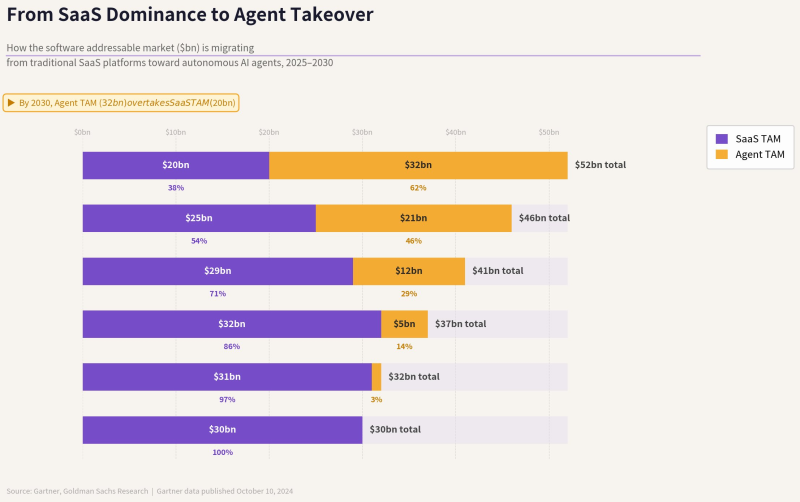
⬤ By 2030, agents are expected to account for more than 60% of software economics, pulling spend away from classic per-seat SaaS subscriptions and toward agent-based workloads. Analysts do not see this as a shrinking market -- rather, the total addressable market is projected to expand as agentic systems automate complex processes across support, sales, marketing, and developer tooling. The emerging infrastructure behind these systems is already taking shape, as explored in AI agent memory 4-layer infrastructure now drives next-gen systems.
Agentic systems could evolve into the new interface for knowledge work, allowing software providers to capture a greater share of AI-generated productivity gains.
⬤ Despite bold projections, most enterprise deployments today are still basic. Tools marketed as AI agents are frequently chatbots wired to large language models, while fully autonomous architectures remain in proof-of-concept or internal pilot stages. Scaling to the next phase will demand stable platform layers paired with robust guardrails for identity, security, and data integrity. Progress toward longer autonomous runs is outlined in AI agents could handle multi-week tasks autonomously by 2027.
⬤ Improvements in reliability, memory, and orchestration are making autonomous execution gradually more practical across enterprise environments. As vendors embed agent-based systems into productivity platforms, competition among major AI providers is already intensifying -- a dynamic covered in depth in Anthropic Claude captures 70% of enterprise AI market, dethroning ChatGPT.
 Eseandre Mordi



