
 Eseandre Mordi

⬤ New data on enterprise AI spending reveals a dramatic competitive shift. According to Ramp Economics Lab - which tracks corporate card and bill-pay data across more than 50,000 U.S. companies - ChatGPT controlled roughly 90% of the U.S. business AI chat market in February 2025. By February 2026, Claude's share had surged to approximately 70%, one of the fastest adoption swings seen in the generative AI sector. This trend connects directly to ongoing questions about Claude reliability metrics and enterprise stability that organizations weigh before committing to a platform.
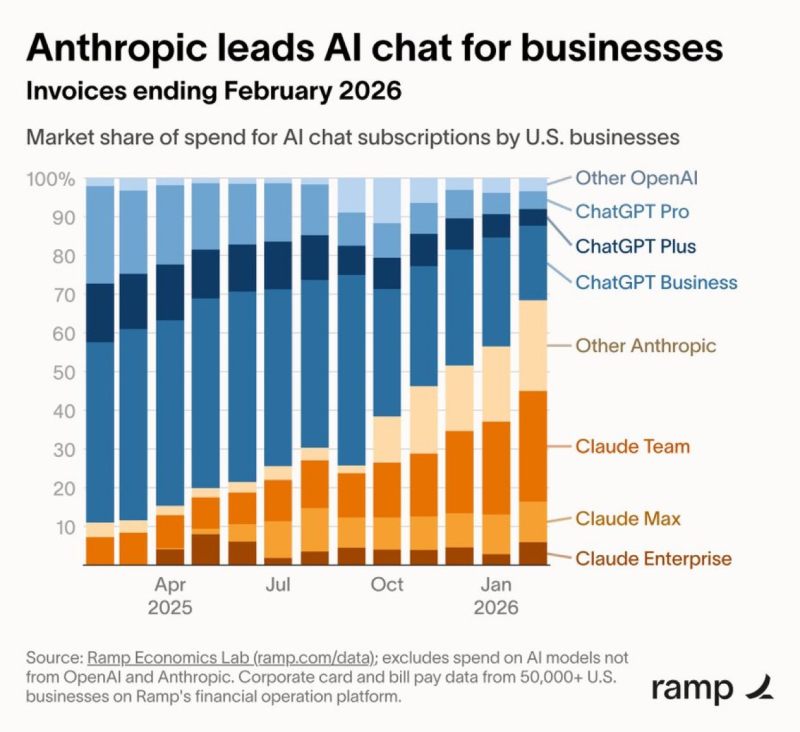
⬤ Month-by-month spending data shows steady growth across Claude Enterprise, Claude Team, and Claude Max throughout 2025, while OpenAI's ChatGPT Business, Plus, and Pro products lost ground. Claude's emphasis on coding workflows, autonomous agents, and enterprise integrations helped it win over technical teams running AI across development pipelines and internal automation. This rapid uptake also mirrors the broader workforce shift tracked in AI job growth tied to language model adoption, where companies keep expanding AI-focused roles.
⬤ Analysts describe the enterprise AI race as the most consequential battleground in the industry. Corporate deployments carry long-term contracts and significantly larger spending commitments than consumer tools, making them a critical prize. Claude's growth reflects demand for platforms that prioritize reliability, security, and developer-first workflows. OpenAI meanwhile continues to invest heavily in enterprise infrastructure. With projections suggesting OpenAI revenue could reach $284B by 2030, the financial stakes of this competition are enormous.
⬤ The speed of this spending shift illustrates how quickly enterprise AI preferences can move when organizations reassess performance, cost efficiency, and integration fit. As AI infrastructure budgets grow and generative models handle increasingly complex workloads, the balance of power between leading platforms stays fluid. The enterprise AI market shows every sign of continued rapid competition and technological change in the years ahead.
 Eseandre Mordi



