
 Saad Ullah
⬤ A new macro scenario built around AI agent capability scaling lays out a striking picture: autonomous AI models are progressing so fast that by 2027, they could handle complex tasks spanning multiple weeks with almost no human input. The "AI Agent Capability Scaling" chart at the center of this discussion maps task length against model release dates, showing a steep upward curve from minutes in early 2024 to multi-day autonomy in 2026. Models like Claude Opus 7 and GPT-6.5 are projected even further along that curve - toward multi-week autonomy by 2027 and 2028.
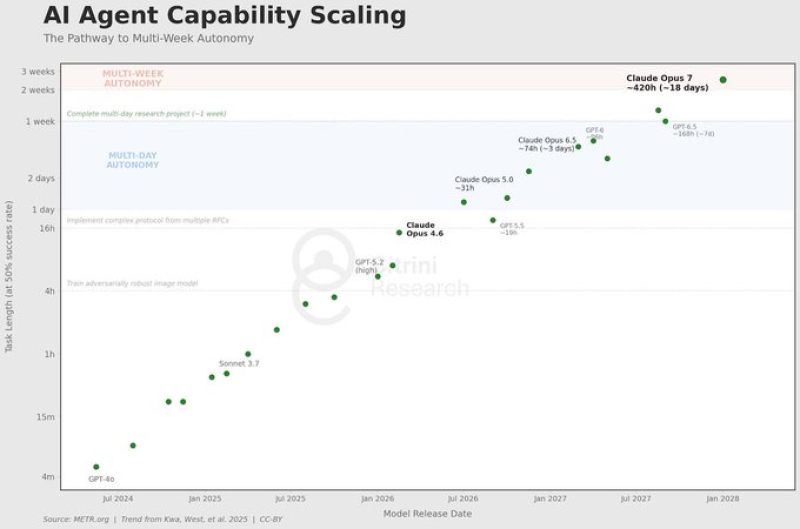
⬤ Earlier models like GPT-4o could complete tasks measured in minutes. What's changed is the pace. Each new generation is plotted at a noticeably larger time scale, suggesting that the gap between human-paced work and machine-paced work is narrowing faster than most anticipated.
An expanding accumulation of capability and compute may outpace job creation in familiar sectors.
⬤ That acceleration has real implications for the workplace. The scenario describes a future where companies use increasingly autonomous AI agents to replace or supplement white-collar roles, compress wages, and potentially reduce consumption if human labor loses comparative value. It's a structural shift, not just a productivity upgrade.
⬤ As compute capacity grows and enterprise workflows absorb more sophisticated models, the intersection of productivity, labor, and financial markets could look very different by the end of the decade. The conversation isn't just about what AI can do - it's about how fast those capabilities scale, and whether economic and workforce structures can adapt in time.
 Saad Ullah



