
 Victoria Bazir

New data on AI usage patterns highlights a widening gap between top-tier users and average employees, as reported by Rohan Paul. The findings show that workers in the 95th percentile of AI adoption are significantly more active than their peers, pointing to uneven integration of artificial intelligence across organizations. The trend underscores how AI deployment alone does not guarantee uniform productivity gains.
According to the data, high-adoption users generate approximately six times more AI messages than the median worker when performing basic chat-based tasks. This aligns directly with the chart, which shows a "6x" increase in individual message intensity.
The divide expands sharply in specialized roles. Among employees working in data analytics, top-tier users interact with AI-powered data tools roughly 16 times more frequently than the median user in the same role, reinforcing the chart's "16x" disparity in advanced tool usage.
AI Adoption Gap Grows as Task Complexity Increases
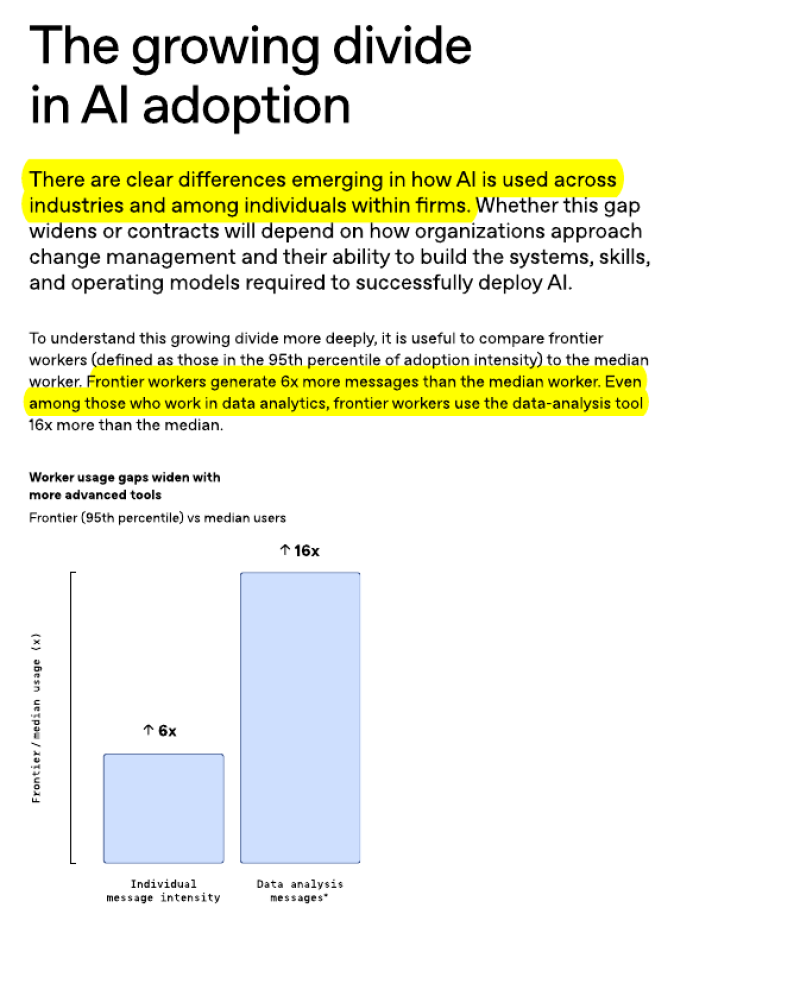
The visual evidence confirms that the divide expands as task complexity increases. While general AI usage is spreading across organizations, the most advanced capabilities are being concentrated among a smaller group of "frontier" users.
The most advanced AI capabilities are clustering around a smaller group of power users, not spreading evenly across teams.
This pattern reflects broader developments in AI systems, where efficiency gains and performance improvements are accelerating rapidly, as Epoch AI's data shows 21,400% efficiency gains driven by compute scaling.
AI Power Users Dominate 16x More in Advanced Tool Usage
The growing disparity in AI adoption highlights a structural shift in how organizations capture value from artificial intelligence. As advanced users increasingly dominate usage of complex tools, outcomes may depend less on access and more on effective implementation and skill development.
As AI workloads scale globally, the organizations that invest in closing the internal adoption gap will be best positioned to capture lasting productivity advantages.
The rise of automation frameworks like Microsoft Copilot Tasks enabling 100-step autonomous workflows further widens this gap, giving power users even more leverage. At the same time, the rapid scaling of AI workloads - highlighted in trends such as China's electricity surge tied to AI demand - points to broader implications for infrastructure, energy consumption, and the future pace of AI-driven transformation.
 Victoria Bazir



