
 Eseandre Mordi

A new AI framework called 3DThinker is changing how machines understand space. As reported by 机器之心 JIQIZHIXIN, the system was developed by researchers from Tsinghua University, Meituan, the National University of Singapore, Beihang University, and LMMs-Lab. It lets AI reason in three dimensions using nothing but 2D image inputs and no labeled 3D datasets at all.
How 3DThinker Builds Internal 3D Representations
The real breakthrough here is not just what the model sees, but how it thinks. Instead of relying on depth maps or external annotations, 3DThinker aligns its internal 3D latent space with a foundational 3D model and sharpens that reasoning through outcome-based learning. This directly addresses a long-standing gap in vision-language models, which have historically leaned on 2D cues or text-based reasoning and consistently struggled with spatial tasks.
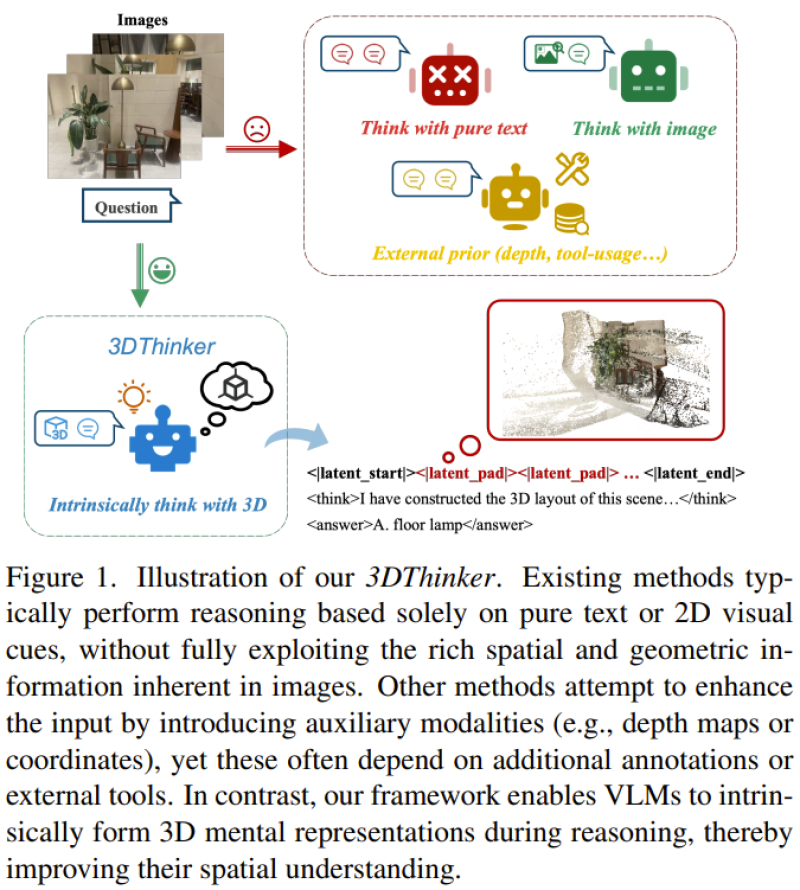
This approach echoes earlier progress covered in Think3D Framework Boosts Vision Models' 3D Spatial Reasoning by 78%, where improved 3D alignment produced significant accuracy gains across geometry-focused benchmarks.
Benchmark Results and Broader Implications
According to the research team, 3DThinker consistently outperforms strong baseline models across multiple benchmarks, with particularly notable results on tasks requiring geometric reasoning and spatial imagination. The model's capacity to simulate 3D structures internally marks a genuine shift toward more human-like perception in AI systems.
The architectural principles share common ground with findings in Why Multi-Agent AI Systems With Specialized Roles Are Outperforming Single Models, where structured reasoning approaches demonstrated clear performance advantages over monolithic designs.
Efficiency gains in latent-based modeling, documented in LatentMorph Boosts Image Generation by 25% While Cutting Inference Time 44%, further illustrate how the field is converging on faster, more capable internal representations.
For applied domains like robotics, autonomous systems, and visual intelligence platforms, the emergence of 3DThinker signals that the next generation of spatial AI may not need 3D data at all to understand the three-dimensional world.
 Eseandre Mordi



