
 Peter Smith

For years, the default approach to building AI systems was straightforward: train one large model and make it do everything. That logic is now being challenged. A growing body of research and real-world deployments shows that distributing tasks across multiple specialized agents produces better results than asking a single system to handle it all. The shift is not incremental. It is redefining how AI infrastructure gets built.
How Specialized Agent Teams Outperform Single-Model Architectures
The core insight driving this transition is that coordination beats generalization when complexity is high. In a well-structured multi-agent system, discrete components handle planning, query rewriting, retrieval, and answer synthesis independently. Each agent operates within a clearly defined scope, which reduces errors and improves overall output quality. Rather than a single overloaded model making sequential decisions, these systems run parallel workflows that are faster and more reliable.
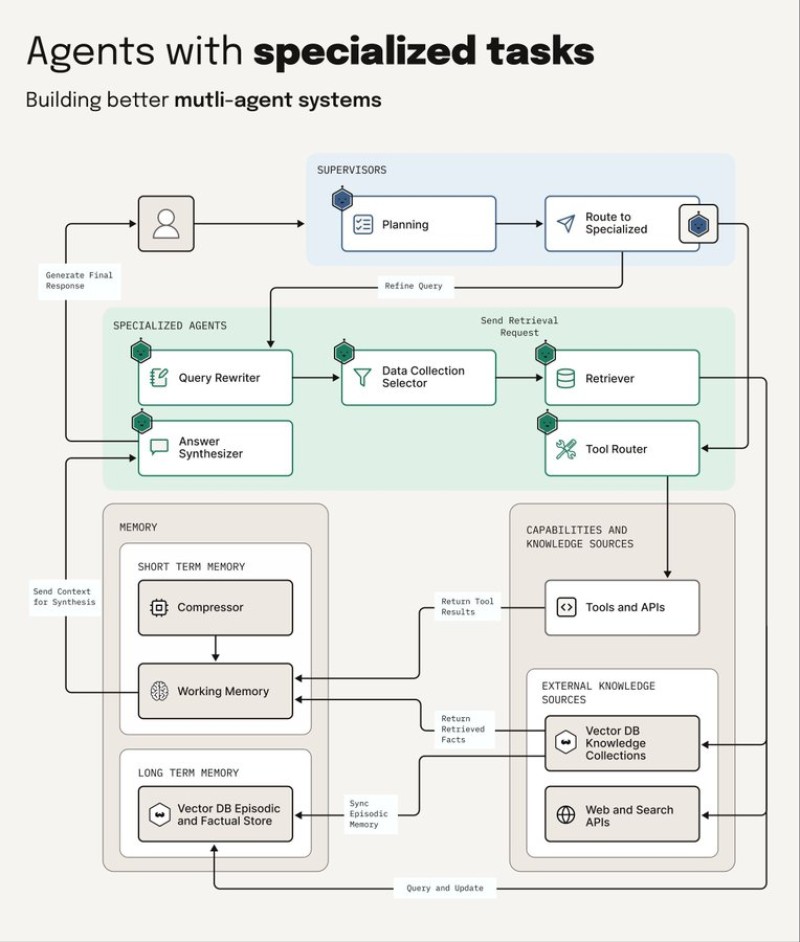
Memory architecture plays an equally important role. Multi-agent systems rely on layered memory structures, where short-term memory tracks active processes and long-term memory stores learned patterns and accumulated knowledge. This separation allows agents to maintain context across complex, multi-step tasks without degrading performance. Industry research confirms that collaborative agent architectures consistently outperform their single-agent counterparts on tasks requiring decomposition and iterative reasoning.
60% of SaaS Profit Pool and the Enterprise Case for Agent-Based AI
The commercial implications are substantial. A Goldman Sachs analysis projects that AI agents could capture 60% of the SaaS profit pool by 2030, driven precisely by the kind of modular, task-specific architectures now gaining traction. Enterprises are investing in infrastructure designed from the ground up for agent workflows. Google's recent move to open-source its Colab MCP Server, giving AI agents direct access to cloud code execution, is one concrete signal of where the ecosystem is heading.
Scalability and adaptability are the attributes that make multi-agent systems attractive for enterprise deployment. Specialized agents can be updated, replaced, or expanded without rebuilding the entire pipeline. As demand for AI solutions capable of handling genuinely complex, real-world workflows increases, multi-agent architectures are fast becoming the foundational layer of next-generation AI infrastructure.
 Peter Smith



