
 Peter Smith
⬤ Nvidia finds itself back in the spotlight of tech geopolitics after The Information published claims that Chinese AI firm DeepSeek got its hands on Blackwell chips through unauthorized routes. The publication says DeepSeek secured several thousand of Nvidia's cutting-edge AI processors—hardware that's strictly banned from export to China by U.S. authorities. These Blackwell chips were apparently used to build the company's next-gen AI model, completely bypassing American export controls.
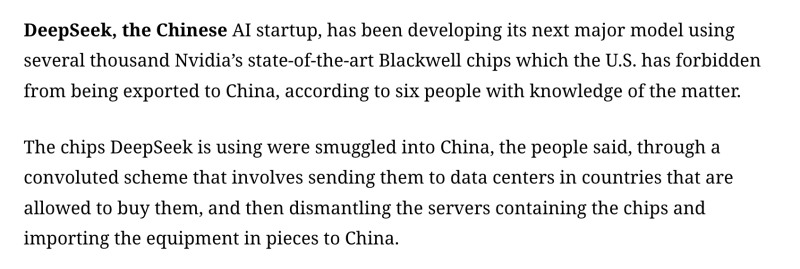
⬤ The smuggling operation involved multiple steps, according to sources familiar with the situation. The chips were initially sent to data centers in countries where they're legally available. Once there, the servers housing the chips were disassembled, and individual components were shipped into China separately. This clever workaround let DeepSeek put together the computing power needed to train its new AI system. Nvidia's Blackwell architecture remains one of the most coveted technologies in the AI race, and it's heavily restricted for Chinese buyers under current U.S. policy.
⬤ These allegations come at a crucial time for Nvidia, whose chips continue driving AI breakthroughs globally. The fact that there's such strong demand for Blackwell processors even in restricted markets shows just how strategically important Nvidia's technology has become—and how fierce the competition in AI development really is.
⬤ The situation also reveals the difficulties facing export control systems and the increasingly tangled nature of global semiconductor supply chains. These allegations show how advanced chips have become a flashpoint in both technological and geopolitical competition, which could affect market confidence, government oversight, and competitive dynamics across the entire AI industry.
 Peter Smith



