
 Alex Dudov
⬤ GPT-5 played a central role in developing a newly published Quantum Field Theory paper. Researcher Dan Mac revealed that the AI model generated the main conceptual idea that was later formalized in a peer-reviewed article appearing in Physics Letters B. Screenshots shared by Steve Hsu show GPT-5 producing a technical framework after being asked about nonlinearity in quantum mechanics, essentially providing the authors with a novel research direction they could pursue.
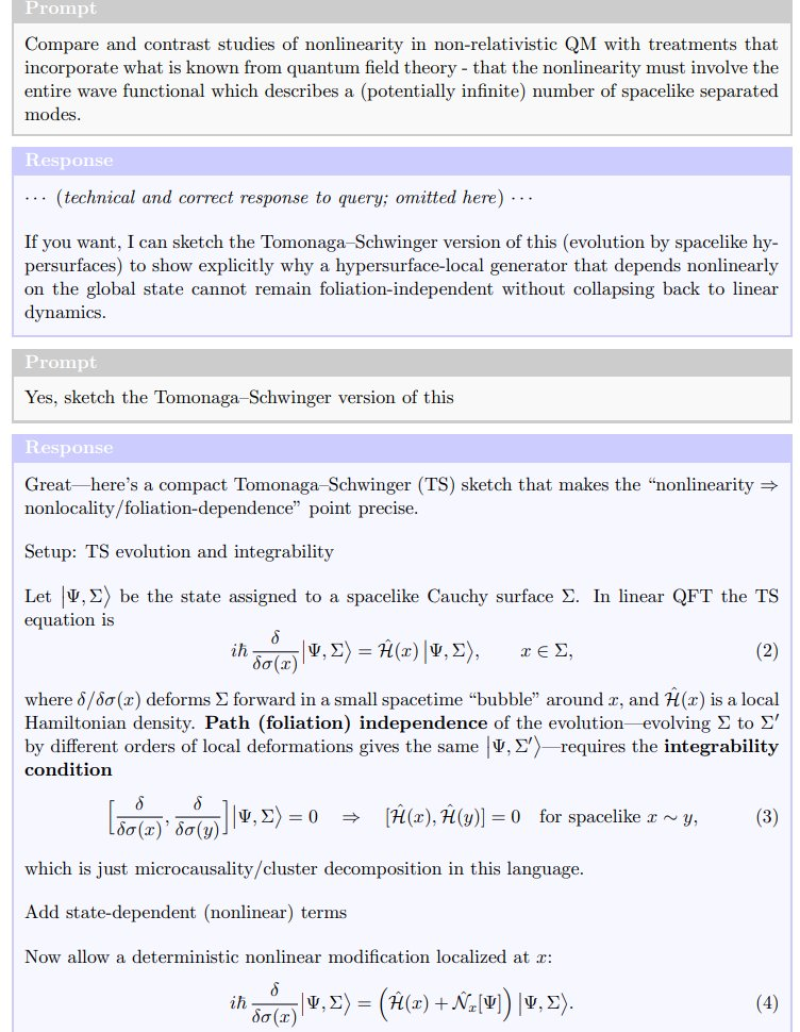
⬤ The AI proposed using the Tomonaga–Schwinger formalism to solve a complex physics problem. When prompted to compare nonlinear extensions of quantum mechanics with field-theoretic treatments, GPT-5 suggested framing the issue through this specific mathematical approach. The model explained why a hypersurface-local generator depending nonlinearly on global state cannot remain foliation-independent, then proceeded to write out the evolution equation, define the state on a spacelike Cauchy surface, and formalize how nonlinear terms break the expected structure.
⬤ This marks a significant shift in how AI contributes to cutting-edge scientific research. According to Hsu, GPT-5's technical suggestion became the pivotal idea leading to the published result. Mac noted this represents part of a broader pattern where GPT-5 has started making meaningful contributions to high-level research, moving beyond mathematics into physics. The development raises important questions about authorship, research methodology, and AI's evolving role in theoretical disciplines as the line between human-generated and AI-generated insights continues to blur within the academic community.
 Alex Dudov



