
 Eseandre Mordi
Google's Gemini AI platform is not slowing down. As most of the internet's biggest websites saw flat or declining traffic in early 2026, Gemini quietly crossed another milestone, pulling in 2.112 billion visits in February alone. For a platform that launched its public rollout just over a year ago, that number signals something more than a trend. It looks like a habit forming across millions of users worldwide.
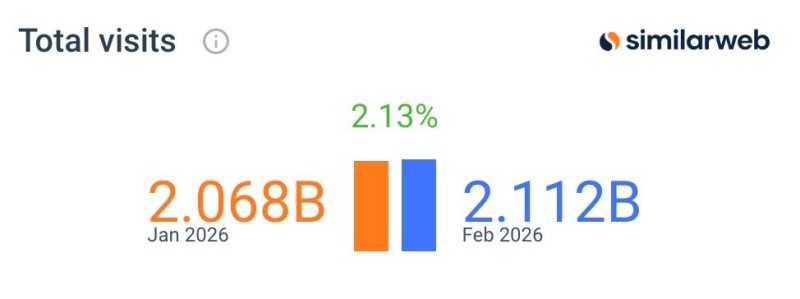
Gemini Records 2.11B Visits in February, Up 2.13% Month Over Month
According to Similarweb analytics, Gemini's February 2026 figure of 2.112 billion visits was up from 2.068 billion in January 2026, a 2.13% month-over-month increase. More notably, this extends Gemini's unbroken streak to 14 consecutive months of period-over-period growth, a run that puts it in rare company among global web platforms. Similarweb data showed Gemini was the only website in the global top-20 rankings to post month-over-month traffic gains during the period, while many major platforms saw stagnation or decline.
That distinction matters. Web traffic at scale is notoriously hard to grow consistently. The fact that Gemini has done it for over a year, while platforms with much longer histories flatlined, suggests genuine user retention rather than novelty-driven spikes. With over 2 billion monthly visits, Gemini now ranks among the most heavily accessed AI services globally, competing directly with platforms that recent benchmarking studies have shown perform very differently across tasks and use cases.
AI Platform Economics: Gemini Competes on Lifetime Value, Not Just Features
Traffic growth is one part of the story. The other is what that traffic is worth. Ongoing expansion of Gemini's feature set, including financial analysis tools, P/E ratio integration, and macro scenario modeling, has broadened its appeal beyond casual users into professional and enterprise workflows. That diversification matters for retention and monetization alike. Analysis of customer lifetime value has placed Gemini at $319, just behind ChatGPT's $332, with both platforms outperforming Google's core search product on that metric. As generative AI tools embed deeper into productivity software, developer tools, and search workflows, the competitive battle is shifting from raw performance benchmarks to ecosystem stickiness and long-term user value, an area where Gemini's sustained traffic growth suggests it is increasingly holding its own.
 Eseandre Mordi



