
 Victoria Bazir
Autonomous AI agents are no longer a side experiment at Cursor. The company has confirmed that cloud agents now account for around 30% of all merged pull requests internally, and the share keeps growing. It's one of the clearest signals yet that AI-driven development has moved from a promising idea into an actual engineering workflow.
What makes this notable isn't just the number — it's how these agents operate. Each one runs inside its own virtual machine with a full development environment: browsers, desktop apps, and every tool a human developer would use. They can take a task from zero, build the feature, run tests, record validation videos, and submit a production-ready PR without anyone touching the keyboard.
Cloud Agents Cover the Full Software Lifecycle Across 5 Platforms
The scope of what these agents handle is broader than typical automation. Cursor uses them for new feature development, UI workflow validation, security vulnerability reproduction, and quick end-to-end bug fixes. They operate across web, mobile, desktop, Slack, and GitHub — covering the entire software lifecycle rather than just isolated tasks. As AI systems move from prediction to action, this kind of multi-platform autonomy is becoming the new standard.
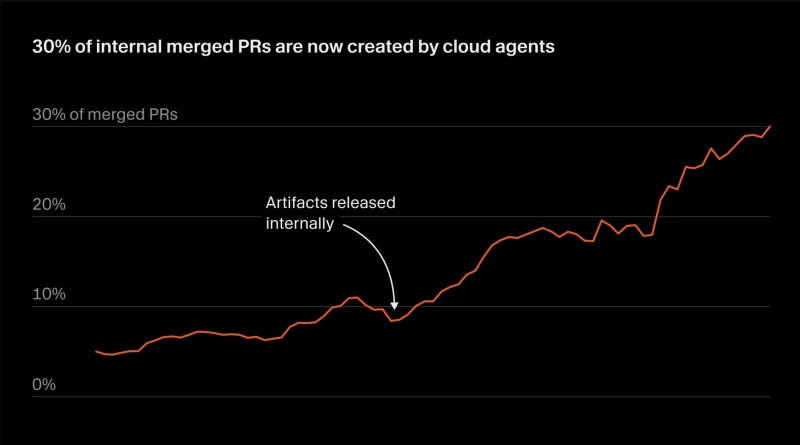
The internal data Cursor shared shows a clear upward trend in agent-generated merged changes over time. There's a visible dip right after certain internal releases, but the overall curve keeps climbing. Handing nearly a third of all merged code to autonomous agents isn't a demo — it's a meaningful operational shift for a team shipping real products.
30% of Merged PRs Is a Signal, Not a Ceiling
The trajectory suggests this number will keep rising. Cursor recently cut agent token usage by 47% with a smarter context system, making these workflows faster and cheaper to run at scale. And Anthropic's data shows 40% productivity gains on complex tasks, reinforcing the efficiency case for AI-driven development.
The broader implication is about how engineering teams are structured. As agents take on more execution, the role of human developers shifts toward direction-setting and output evaluation. That changes how work gets reviewed, how quality is maintained, and ultimately how teams think about what it means to write software together.
 Victoria Bazir



