
 Marina Lyubimova

⬤ A recent research overview lays out a roadmap for building agentic intelligence into scientific discovery. The study shows how AI is moving beyond passive number-crunching into systems that can actually plan experiments and adjust based on what happens.
⬤ The framework breaks development into three stages. Early systems were straightforward predictors—feed them data, get property scores back, end of story. Today's reasoning models can read scientific papers, process complex text, and come up with hypotheses. But the next step changes everything: agentic systems that don't just suggest ideas but connect directly to robots and simulations in a feedback loop. We're already seeing hints of this shift in AI coding assistants gaining agent skills.
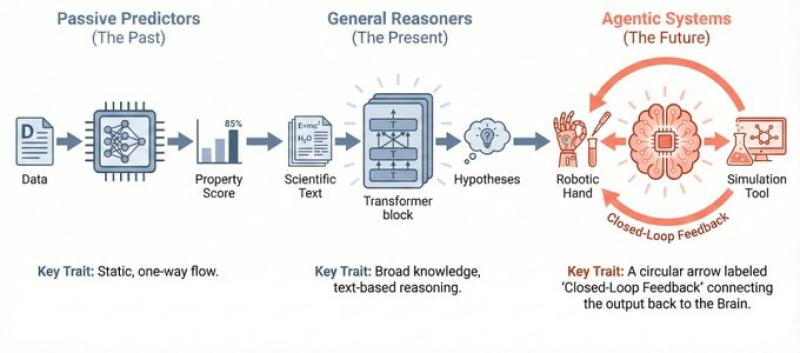
⬤ Here's where it gets interesting. Instead of waiting for humans to run tests, these models kick off experiments themselves. Simulations stress-test the hypotheses, robotic labs carry out the physical work, and results flow back to the AI for another round of refinement. Systems like Moonshot AI's Kimi k25 running multiple AI agents at once show how coordination between agents and tools is becoming standard practice.
⬤ This isn't just a technical upgrade—it's a fundamental shift in how AI fits into research and industry. The framework connects computation with real-world testing, turning AI from an analytical tool into an active participant in discovery. Whether it's drug development, materials science, or engineering, these systems are learning to experiment, not just observe.
 Marina Lyubimova



