
 Saad Ullah

Anthropic's latest AI model release is shaking up the automation landscape. Just two weeks after launching Opus 4.6, the company introduced Claude Sonnet 4.6, and early testing suggests it might be the sweet spot for businesses running automated workflows. Zapier's internal benchmarks show the new model delivering Opus-level accuracy at significantly lower computational costs.
Claude Sonnet 4.6 Outperforms Previous Versions in Real-World Tasks
Anthropic rolled out Claude Sonnet 4.6 in rapid succession after Opus 4.6, and the timing makes sense given what Zapier discovered in their testing. The company put Sonnet 4.6 head-to-head with both its predecessor, Sonnet 4.5, and the larger Opus 4.6 model across dozens of real automation scenarios.
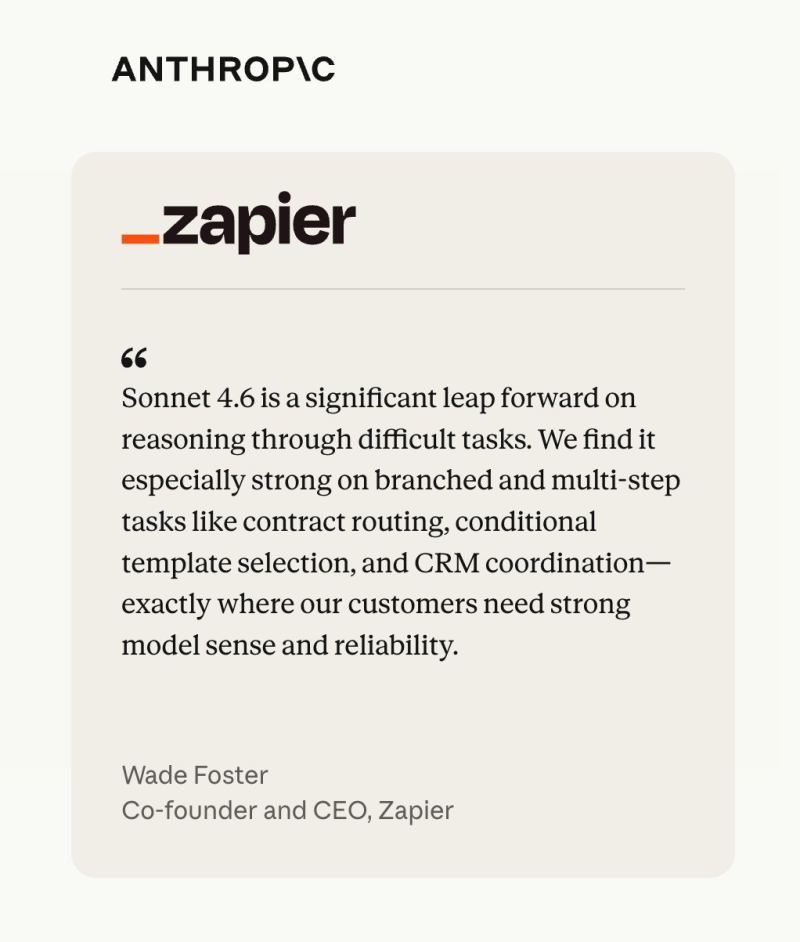
The tests weren't theoretical exercises. Zapier focused on actual operational workflows like syncing calendars with CRM systems, routing tasks based on conditions, and executing multi-step processes where one mistake could derail everything. These are the bread-and-butter tasks that businesses rely on daily.
Sonnet 4.6 Becomes Only Model to Complete Certain Workflows Perfectly
Here's where things get interesting. In several benchmark tests, Claude Sonnet 4.6 was the only model that nailed the workflow from start to finish. We're talking about tasks that required the AI to evaluate conditions, pull the right records from databases, and choose the correct execution path without human intervention.
Wade Foster, Zapier's CEO, highlighted the significance: Claude Sonnet 4.6 was the only model that completed certain workflows correctly end-to-end.
Even small error rates in these scenarios can break entire automation chains, so the jump in reliability from Sonnet 4.5 represents a meaningful upgrade for anyone running production workflows.
Token Efficiency Makes Sonnet 4.6 the Default Choice for Most Automations
Beyond accuracy, Sonnet 4.6 brings efficiency gains that matter for scaling. The model consumes fewer tokens than earlier versions while maintaining the same reliability in structured tasks. That translates directly to lower costs and faster execution times.
Zapier announced it will make Sonnet 4.6 its default model for most automation use cases, including conditional routing, document processing, and CRM coordination. Opus 4.6 isn't going anywhere though. The larger model still handles complex scenarios better, particularly heavy coding tasks, multi-tool reasoning, and workflows that need extensive error recovery.
AI Models Show Clear Specialization in Production Deployments
What we're seeing here is AI models carving out distinct roles. Sonnet 4.6 targets dependable, day-to-day automation, the kind of stuff that needs to work reliably without consuming unnecessary resources. Meanwhile, Opus-class models tackle the heavyweight reasoning and synthesis work.
This split reflects where the industry is heading. As AI gets deployed in real production environments, efficiency and reliability matter as much as raw capability. Companies need models that can handle routine tasks consistently without breaking the bank on compute costs.
The rapid release of Sonnet 4.6 after Opus suggests Anthropic is moving toward a tiered model approach, giving users the right tool for each job rather than one model trying to do everything.
 Saad Ullah



