
 Eseandre Mordi
Anthropic is preparing a major leap forward with a new model tier called "Capybara," according to details highlighted by Lisan al Gaib and supported by draft company materials. Positioned above the Claude Opus line, Capybara marks what Anthropic describes as a step change in capability and signals a structural shift in the company's AI hierarchy. Early-access users are reportedly already testing the model, making it the most advanced system the company has built to date.
Capybara AI Expands Anthropic's Model Stack Beyond Opus
According to the leaked draft blog post, Capybara is described as "larger and more intelligent" than Opus models, which previously held the top spot in Anthropic's lineup. The existing hierarchy includes Haiku, Sonnet, and Opus, each tuned for different performance and cost tradeoffs. Capybara now adds a new upper layer, effectively stretching the stack beyond its previous ceiling.
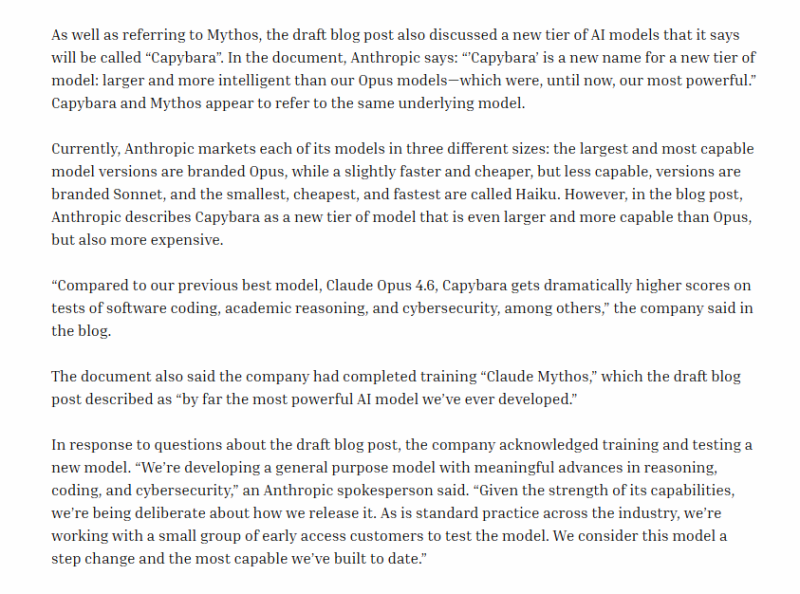
The materials also reference "Claude Mythos," described internally as the most powerful AI model Anthropic has ever developed. This development fits squarely within broader industry patterns explored in Anthropic researchers launch $1B startup Mirendil, where rapid innovation cycles continue to accelerate across AI ecosystems.
Capybara is defined as 'larger and more intelligent' than Opus models - introducing a new upper layer that expands the model stack beyond its previous limits.
Capybara Scores Higher on Coding, Reasoning, and Cybersecurity Benchmarks
Performance improvements are central to Capybara's positioning. Anthropic claims the model delivers "dramatically higher scores" across key benchmarks, including software coding, academic reasoning, and cybersecurity - areas that define enterprise-grade AI performance. The leaked materials also flag potential risks tied to these same capabilities, particularly in cybersecurity, where the system may outpace existing defenses by a wide margin. These gains reflect a broader shift discussed in coverage of multi-agent AI systems outperforming single models, where performance breakthroughs increasingly come from architectural evolution rather than plain scaling.
The leaked materials highlight potential risks tied to Capybara's capabilities - particularly in cybersecurity, where the system may significantly outperform existing defenses.
Capybara Signals a New Phase in Anthropic's AI Capability Race
The introduction of Capybara underscores the intensifying race among AI developers to push beyond current model limits. As Anthropic moves past Opus into a new tier, the shift points toward systems that are both more powerful and likely more resource-intensive. Benchmark-driven competition remains a key driver, as seen in reporting on Claude Sonnet 4.6 ranking among top AI models, where performance metrics increasingly shape market positioning. Capybara suggests the next phase of AI development will be defined not by incremental improvements, but by entirely new capability tiers.
The emergence of Capybara suggests that the next phase of AI development will be defined not just by incremental gains, but by entirely new tiers of capability.
Key takeaways from the Capybara announcement:
- New model tier positioned above Claude Opus, expanding Anthropic's existing Haiku/Sonnet/Opus hierarchy
- Linked internally to "Claude Mythos," described as Anthropic's most powerful AI model to date
- Dramatically higher benchmark scores in coding, academic reasoning, and cybersecurity
- Potential cybersecurity risks flagged in leaked materials due to the model's advanced capabilities
- Already being tested with early-access users ahead of a broader release
 Eseandre Mordi



