
 Eseandre Mordi
⬤ Google (NASDAQ: GOOGL) has unveiled a new AI architecture called the Always-On Memory Agent, built using Google's Agent Development Kit and the Gemini 3.1 Flash-Lite model. The framework enables AI agents to continuously ingest and process multimodal data - text, images, audio, video and PDF documents - creating a persistent memory layer that mirrors how the human brain organizes information over time.
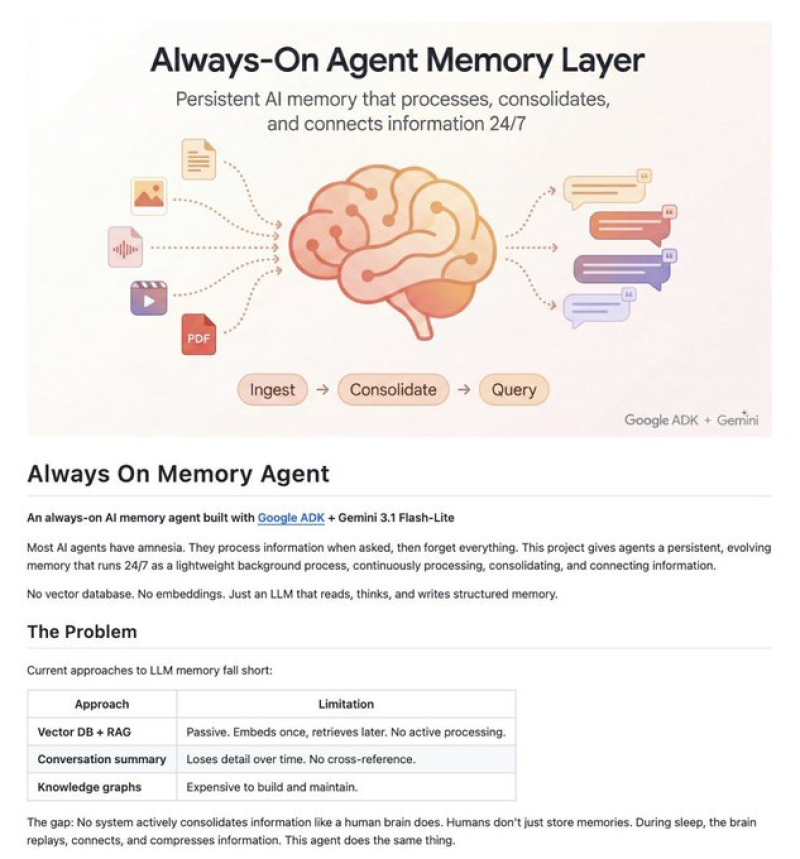
⬤ Unlike traditional AI tools that only process data when prompted, the Always-On Memory Agent runs as a true 24/7 background process - constantly reading new inputs and organizing them into structured memory. This directly addresses one of the most common limitations in modern AI agents: they handle tasks in isolated bursts, then discard context entirely once the session ends.
The design enables the model to read, organize and update information continuously - without requiring external vector storage infrastructure.
⬤ A key technical distinction is what the system doesn't use. Instead of relying on vector databases and embedding pipelines - the standard retrieval approach in most AI apps - the Always-On Memory Agent lets a large language model directly manage structured memory and knowledge consolidation, cutting out external storage infrastructure entirely.
⬤ Google released the project as fully open source, inviting developers to experiment with persistent memory architectures. The move reflects a broader industry pivot toward AI systems capable of long-running autonomous workflows and continuous contextual awareness - capabilities that could reshape how agents handle knowledge retention across research, automation and enterprise software.
 Eseandre Mordi



