
 Saad Ullah
A major research breakthrough in AI training has emerged from a collaboration between NVIDIA, the University of Oxford, and other institutions. As Oliver Prompts reported, the study presents EGGROLL - a method based on evolution strategies (ES) that enables optimization of large models without relying on traditional backpropagation. Rather than using derivatives, the approach updates models through population-based perturbations and evaluation, opening a genuinely different path forward for large-scale AI training.
How EGGROLL Solves the Scalability Problem in Gradient-Free AI Training
The core innovation in EGGROLL lies in replacing full-rank perturbations with low-rank matrix structures, which significantly cuts both computational load and memory usage. This architectural choice allows the system to run efficiently at large scale while still producing expressive model updates - something that previous evolution strategy methods consistently failed to deliver.
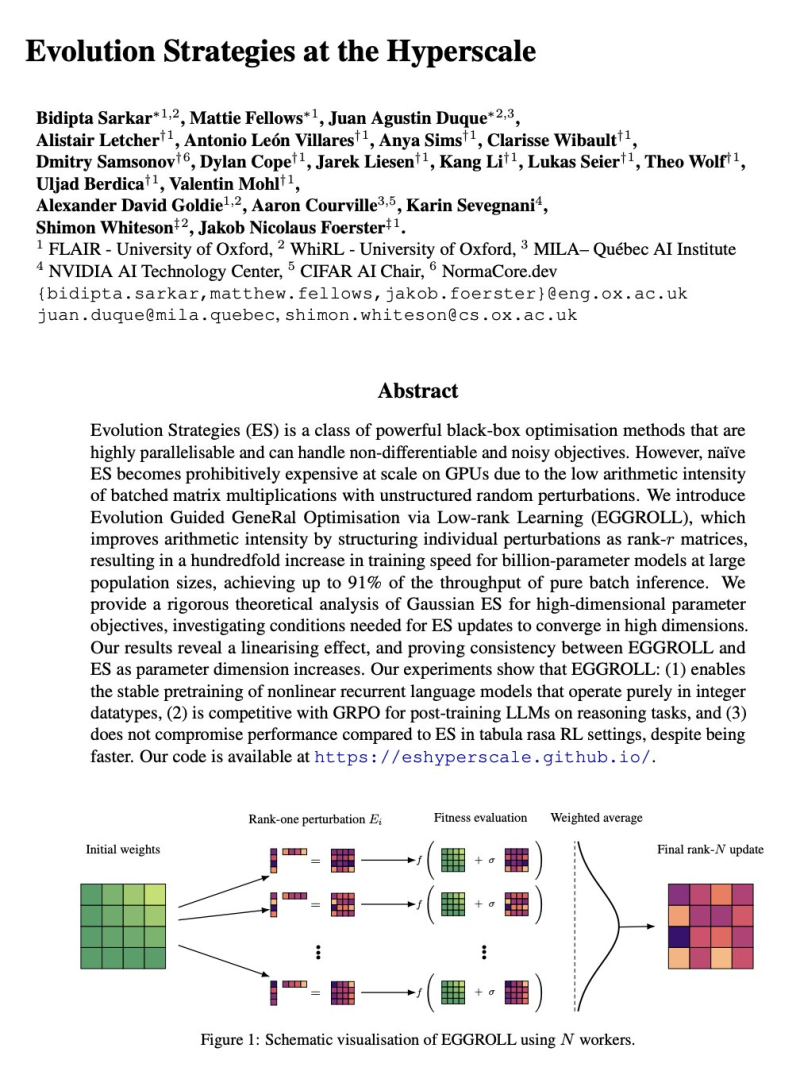
Experiments confirm that EGGROLL can reach up to 91% of the throughput of standard batch inference, a substantial leap in training efficiency for a gradient-free approach.
The shift from full-rank to low-rank perturbations is not a minor tweak - it fundamentally changes what is computationally feasible for evolution-based training at scale.
The method also enables highly parallel optimization by evaluating large populations of model variations at the same time. This parallelism makes evolution strategies far more practical for modern large-scale models, clearing the bottlenecks that previously made unstructured perturbations impractical. Related work on EGGROLL's training speed gains points to a broader shift underway in how AI optimization is being approached.
EGGROLL Performance and Support for Integer Data Formats
Beyond raw throughput, EGGROLL demonstrates competitive performance against existing optimization approaches on select tasks. Notably, the method supports training in integer data formats - a practical advantage for deployment scenarios where reduced precision matters for speed and hardware efficiency.
What makes this compelling is not just the efficiency numbers but the fact that the system remains competitive on real tasks, not just synthetic benchmarks.
Findings like these align with ongoing research into multi-agent AI systems outperforming single models, as both directions push toward more efficient and scalable AI architectures.
Why Gradient-Free AI Optimization Methods Are Gaining Ground
The findings reflect growing industry interest in optimization techniques that reduce dependence on gradient-based training. As AI systems continue scaling in size and complexity, methods that improve parallelization and reduce memory overhead are becoming increasingly strategic. This trend connects naturally to broader infrastructure developments, including NVIDIA and Microsoft driving AI energy initiatives, where advances in training efficiency could directly shape how future AI systems are built and deployed.
 Saad Ullah



