
 Saad Ullah
Document AI just got a serious upgrade. Zhipu AI has released GLM-OCR, a 0.9-billion-parameter multimodal model that combines optical character recognition with deep document understanding, and it's already sitting at the top of OmniDocBench, one of the field's toughest evaluation benchmarks.
How GLM-OCR's 0.9B Architecture Works
The model pairs a 0.4B-parameter CogViT visual encoder with a 0.5B-parameter GLM language decoder. What sets it apart is a built-in Multi-Token Prediction (MTP) mechanism that lets the model generate several tokens per step rather than one. The result is faster decoding with lower memory overhead, something traditional autoregressive OCR systems have consistently struggled to deliver. This efficiency-first approach mirrors gains seen elsewhere in the space, including Sarvam AI's two new reasoning models at 30B and 105B parameters built around efficient attention architectures.
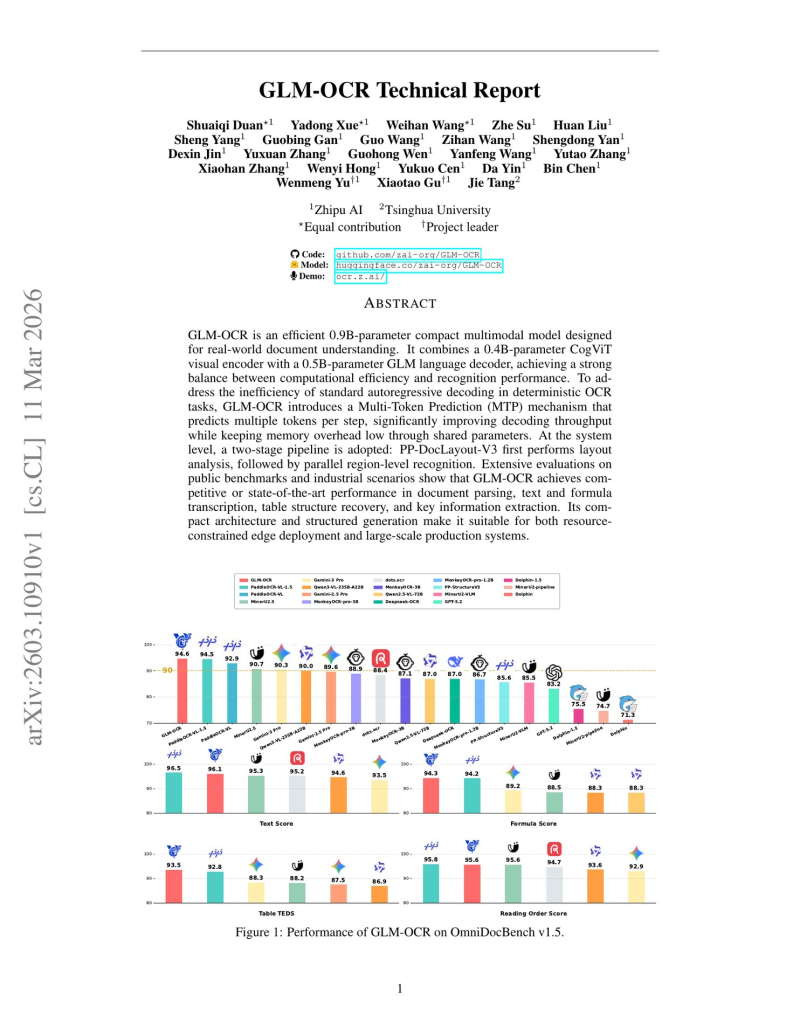
Before region-level text extraction begins, a two-stage pipeline kicks in: PP-DocLayout-V3 first handles document layout analysis, segmenting the page into logical zones. Only then does GLM-OCR process each region for text, tables, formulas, and reading order, keeping structured data recovery accurate even on complex layouts. This kind of structured reasoning at the architecture level is also what drives results like IBM's agent memory system, which boosted task success rates by 149%.
Benchmark Results Across Text, Tables, and Formulas
On OmniDocBench, GLM-OCR claimed first place across multiple evaluation categories, including text transcription accuracy, table structure recovery, formula recognition, and reading order detection. The gains hold up against both dedicated OCR systems and larger multimodal competitors, making the model's efficiency argument hard to ignore.
The practical applications are clear: enterprises running document automation pipelines stand to benefit from a model that processes complex layouts reliably without demanding heavy compute. As AI integration into data extraction workflows accelerates, efficiency per parameter is becoming a key competitive metric, a trend also visible in forecasts tracking Anthropic's potential to surpass OpenAI in annualized revenue by mid-2026 as deployment costs come under closer scrutiny.
 Saad Ullah



