
 Saad Ullah

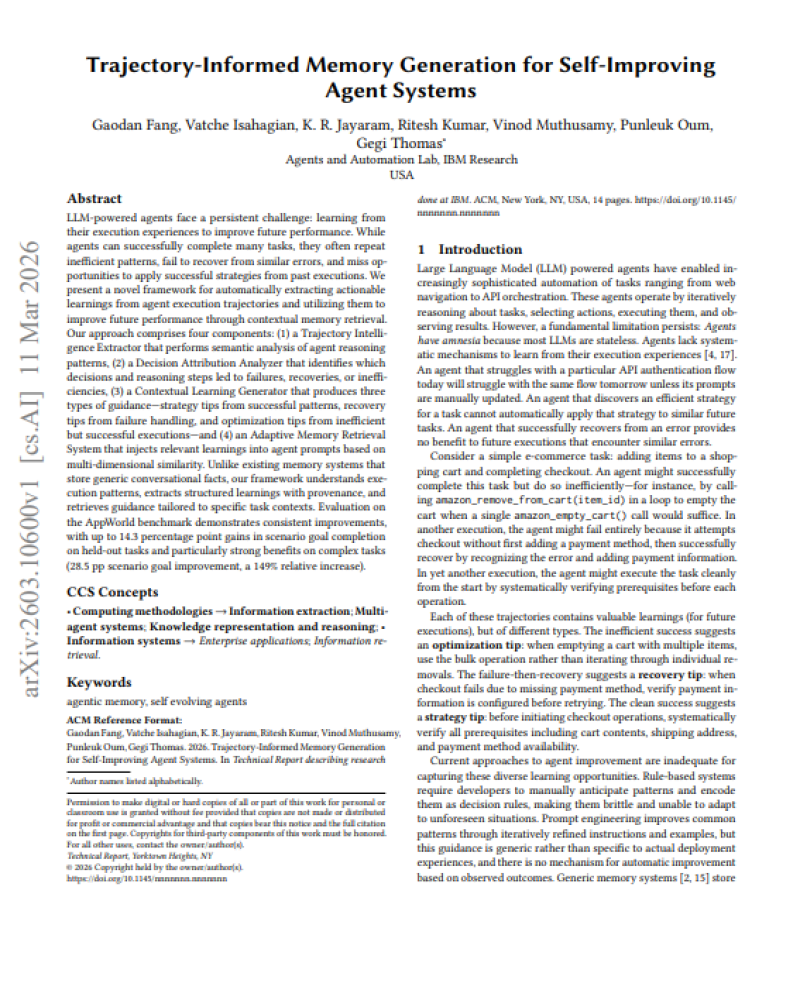
IBM researchers have introduced a framework that tackles one of autonomous AI's most stubborn problems: agents that forget everything after each task. The system, described in the paper Trajectory-Informed Memory Generation for Self-Improving Agent Systems, captures full execution histories and converts them into reusable guidance for future tasks. This means an agent can now remember what worked, what failed, and where it wasted steps.
How IBM's Memory Layer Works Without Retraining
Most AI agents today start every task from scratch, with no record of past attempts. IBM's framework changes that by analyzing each agent's full execution trajectory, extracting structured insights from it, and injecting that context into future prompts. The memory layer evolves continuously while the underlying model stays untouched, making the approach practical for enterprise environments where retraining large models is costly and slow. IBM hits 95 on AI Transparency Index while industry average drops, underscoring the company's broader push toward accountable AI practices.
149% Completion Rate Gains on Complex Multi-Step Workflows
The performance numbers are hard to ignore. On new, previously unseen tasks, the framework delivered up to a 14.3 percentage-point increase in scenario completion rates. For complex workflows spanning more than 50 steps across multiple applications, results were even more striking: completion rates climbed from 19.1% to 47.6%, a 149% relative improvement. IBM and University of Washington launch open AI dataset, part of a wider push to advance open research alongside commercial AI development.
The results point to a broader shift in how AI systems improve over time. Rather than depending on ever-larger models, IBM's approach shows that smarter agent architectures, specifically ones with better memory, can meaningfully close the gap in real-world task performance. For enterprise automation, where multi-step workflows across software systems are the norm, frameworks like this could be the practical path to reliable AI agents at scale.
 Saad Ullah



