
 Marina Lyubimova
Anthropic has published new research on how AI tools are reshaping professional work, and the gap it reveals is striking. The study compares what large language models could theoretically do across occupations with how much AI is actually being used day-to-day. The results are fueling debate about what some researchers are calling a potential "Great Recession for white-collar workers."
AI Capability vs. Reality: The Numbers Behind the Gap
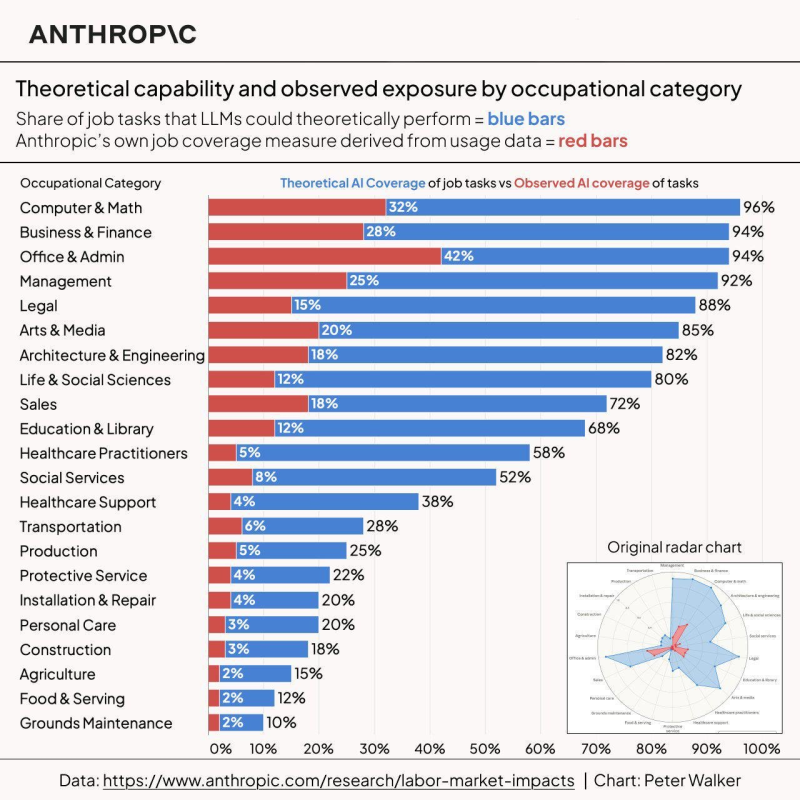
The research maps theoretical AI task coverage across major job categories. Computer and math roles top the list at around 96%, followed closely by business and finance at 94% and office and administrative work at roughly the same level. Management comes in near 92%, legal occupations around 88%, and arts and media at about 85%. According to Anthropic's findings on programmer AI exposure, computer professionals alone face 74.5% direct exposure, with wages running 47% higher in the most at-risk roles.
Real-world AI adoption remains far below what the technology could theoretically achieve, highlighting a significant adoption gap across industries.
But theoretical capability and real usage are two very different things. Observed AI adoption in computer and math roles sits at just 32%, business and finance at 28%, and office and administrative work at around 42%. The gap between what AI can do and what workers are actually using it for remains enormous across the board.
No Mass Layoffs Yet, But Early Signals Are Emerging
The report notes that widespread job displacement hasn't shown up in the unemployment data yet. Occupations with high AI exposure haven't seen a clear spike in joblessness. Still, early signals are there: slower hiring in certain knowledge-work fields is already visible, and the study offers one of the most detailed looks yet at how AI is gradually embedding itself into professional workflows.
For companies navigating this shift, tools like Claude Auto Mode are already designed to reduce interruptions in technical workflows, pointing to how AI augmentation is advancing faster than most hiring trends reflect. Meanwhile, growing interest in resources like Anthropic's free prompt engineering course, which has crossed 31,900 GitHub stars, suggests workers across industries are actively preparing for a more AI-integrated future.
The study makes clear that the technology is ahead of adoption, not the other way around. How quickly that gap closes may determine which white-collar professions transform gradually and which face more sudden disruption.
 Marina Lyubimova



