
 Peter Smith
Artificial intelligence is no longer a distant disruption for most workers; it is an active variable reshaping which tasks get done by humans and which get handed off to algorithms. A new report from Anthropic puts hard numbers to that shift, ranking occupations by how exposed they already are to AI-driven automation. The findings arrive at a moment when public attention toward the company is growing, as detailed in Public exposure to Anthropic's $380B valuation surge: what investors should know.
Which Roles Face the Highest AI Exposure in 2025?
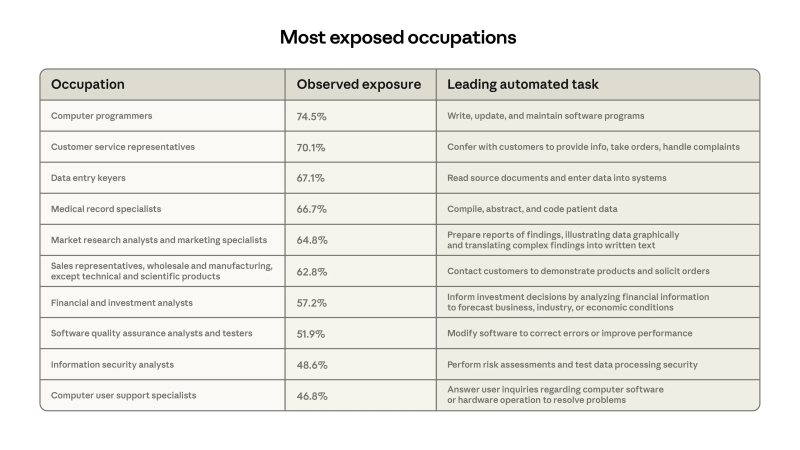
The report's occupational rankings are striking. Computer programmers top the list with a 74.5% observed AI exposure rate, followed by customer service representatives at 70.1%, data entry keyers at 67.1%, and medical record specialists at 66.7%. Market research analysts, financial and investment analysts, software quality assurance testers, and information security analysts all appear in the high-exposure tier as well.

The data also maps exposure by broad job sector. Management, business and finance, computer and mathematics, architecture and engineering, and legal professions register the highest theoretical AI coverage. Yet across nearly all these categories, real-world adoption trails the technical ceiling by a wide margin, pointing to organizational, regulatory, and cultural barriers that still slow deployment.
Higher AI Exposure Correlates With Higher Pay and Education
One of the report's more counterintuitive findings concerns wages. Workers in the highest AI-exposure quartile earn an average of $32.69 per hour, compared with $22.23 for workers in roles with no measured AI exposure. Those higher-exposure positions also tend to require more formal education, suggesting that AI is currently concentrating its near-term impact on skilled, well-compensated work rather than low-wage, routine labor. The broader infrastructure enabling this shift continues to scale rapidly, with projects like the OpenAI $500B Stargate initiative driving a U.S. AI data center boom.
The same dynamic is visible in creative and professional workflows. AI tools are increasingly woven into content production pipelines, with platforms such as the TopViewAI vibe editing tool enabling no-code video creation illustrating how automation is expanding beyond traditional white-collar tasks into media production as well.
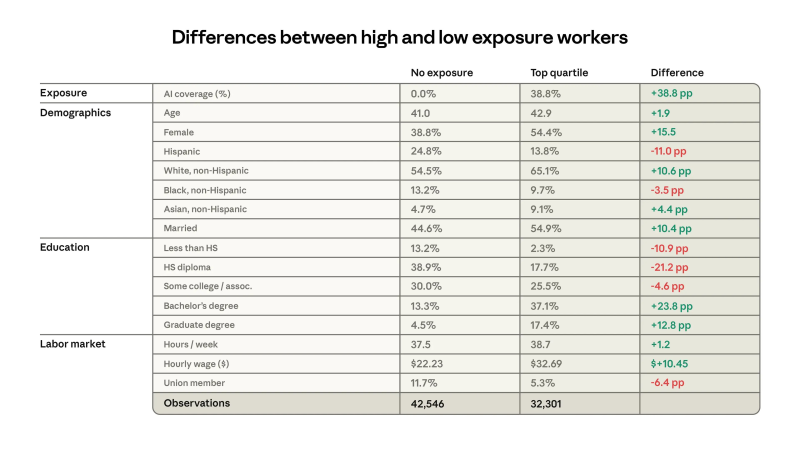
Taken together, the Anthropic report offers a nuanced picture: AI's theoretical reach is broad, its real-world footprint is still catching up, and the workers closest to that frontier tend to be the most educated and the best paid.
 Peter Smith



