Saad Ullah

⬤ Anthropic has introduced Auto Mode for Claude Code, targeting long coding sessions where developers are repeatedly pulled away from their work by approval prompts. Entering research preview now, the feature is set to roll out no earlier than March 12, 2026, and lets Claude handle permission decisions automatically so developers can run extended processes without constant interruption. The announcement builds on Anthropic's broader push to advance its coding models, as highlighted in Claude Opus 4.6 leads as SWE-Bench reshapes AI coding rankings.
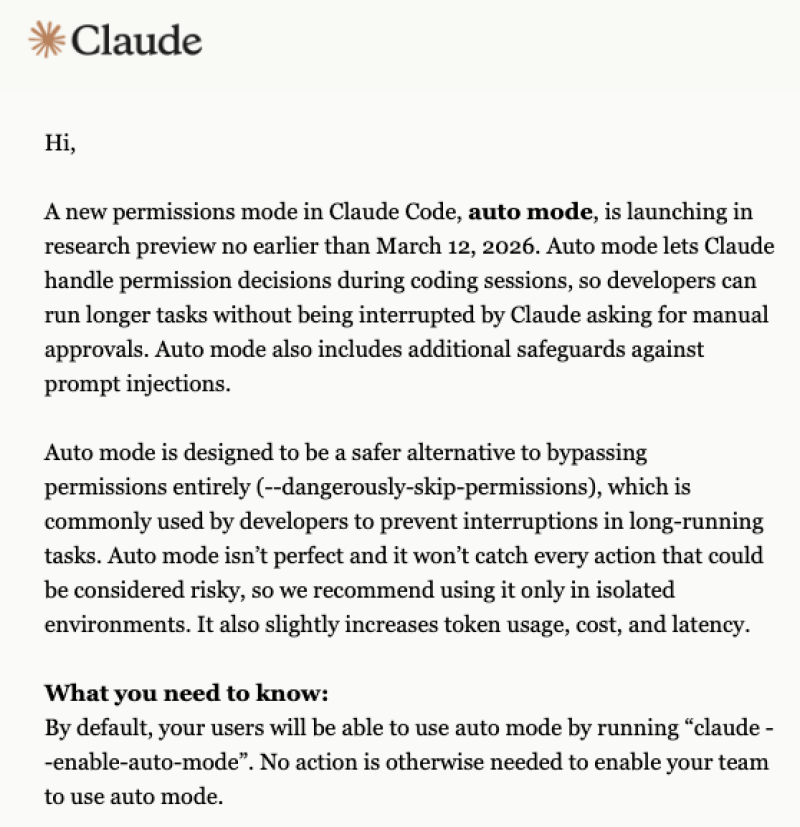
⬤ Previously, developers working on complex tasks had to manually approve each action Claude took, breaking workflow momentum at critical moments. Auto Mode is designed to eliminate those friction points while keeping built-in safeguards active. The growing ecosystem around Claude continues to benefit from these kinds of improvements, as seen in projects like NanoClaw AI launch, a Claude-powered assistant that gained 350 developer stars.
Auto Mode is still in research preview and may not detect every potentially risky action. Developers are advised to test it in sandboxes or containers.
⬤ Anthropic also added protections against prompt injection attacks, a rising threat in AI-assisted coding. The company was upfront about trade-offs: enabling Auto Mode may result in slightly higher token usage, cost, and latency due to additional security checks the model performs before acting. Developers are encouraged to run the feature in isolated environments during early testing.
⬤ The release reflects how AI coding tools are maturing to handle longer, more autonomous development sessions. By reducing interruptions without dropping security controls, Anthropic is positioning Claude Code as a more capable partner for serious engineering work. The competitive pressure is mounting too, with Grok Code set to match Claude's performance by April 2025 signaling how fast the space is moving.
 Saad Ullah