
 Saad Ullah

⬤ NanoClaw has arrived as a stripped-down alternative to bulkier personal AI assistants, designed to be both lightweight and secure from the ground up. NanoClaw delivers the same punch as more complex frameworks while keeping its codebase simple enough to understand in just a few minutes. Built on Anthropic's Claude AI ecosystem, NanoClaw runs safely inside isolated containers and lets multiple AI agents work together, opening up new ways to build Claude-powered workflows.
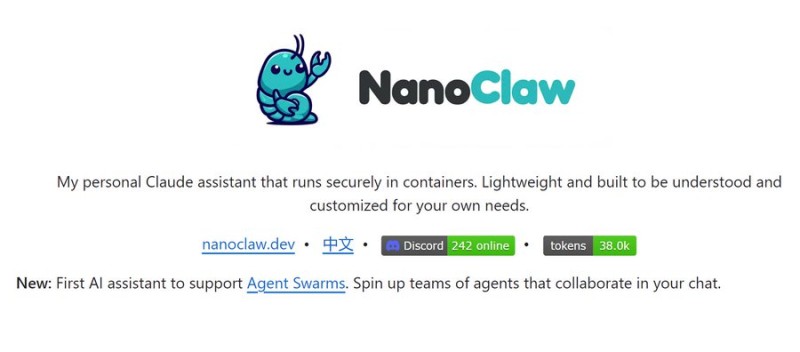
⬤ The NanoClaw interface shown in the image highlights its community-first approach and developer focus, with features like WhatsApp I/O, scheduled tasks, and web access all running through container-based autonomy. Unlike heavier solutions, NanoClaw keeps things intentionally minimal - cutting down on configuration headaches while keeping all the core capabilities intact. "We wanted something developers could spin up and actually understand, not another black box," the team emphasized in their documentation. Its "Agent Swarms" feature lets groups of Claude agents collaborate right inside the chat environment, boosting workflow complexity without requiring massive backend infrastructure. Container isolation makes sure each agent operates securely with controlled filesystem access, tackling the challenge of managing AI workloads in both development and production setups. Using Claude Code as its execution engine, NanoClaw connects chat input with agent tasks running in Docker or Apple Container environments on macOS.
⬤ The push toward simpler, more secure personal assistants mirrors a bigger shift in the AI world where developers want tools that balance power and control with transparency and ease of use. Anthropic's Claude family, including flagship releases like Claude Opus 4.6 and Sonnet variants, has been leading the charge in advanced agentic reasoning and task execution at scale. Recent model upgrades have focused on bigger context windows and collaborative capabilities - features that line up perfectly with NanoClaw's emphasis on agent swarms and extensibility.
⬤ NanoClaw's introduction highlights the growing appetite for tailored AI assistants that fit securely into user workflows without unnecessary complexity. By combining container isolation with modular extensions and collaborative agent structures, NanoClaw shows how next-generation AI tools are evolving to meet the needs of developers, research teams, and technical communities.
 Saad Ullah



