
 Victoria Bazir

⬤ Research from the Similarweb Market Research Panel (US, Jan 2026) shows that consumer purchase journeys are splitting between AI tools and traditional search engines. AI tools now dominate the earliest stages of discovery and inspiration, while search engines reclaim relevance when people compare options and make final decisions. These findings reflect a broader wave of no-code video creation platforms and other AI-powered tools reshaping how people interact with information online.
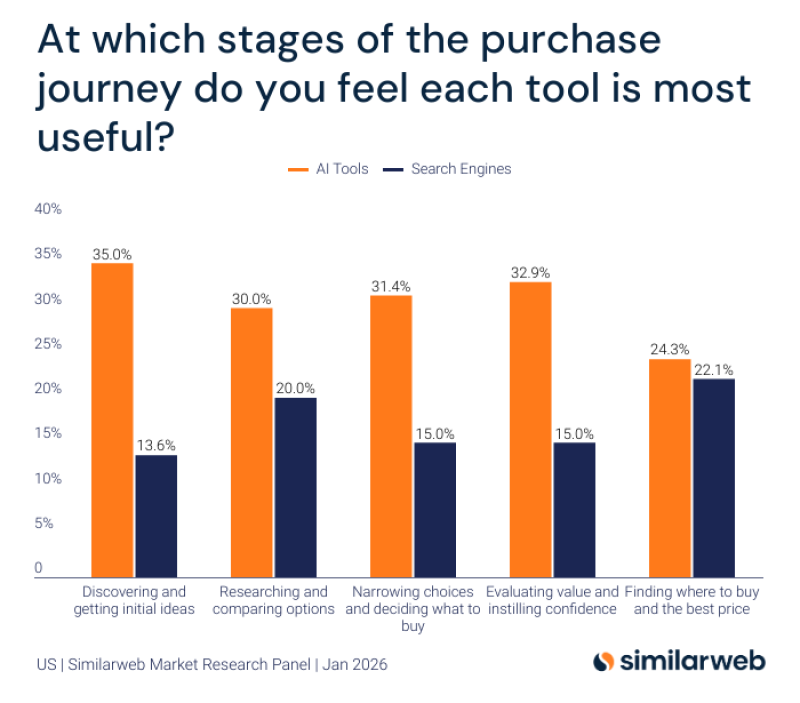
⬤ The numbers tell a clear story: 35.0% of respondents find AI tools most useful for initial discovery and idea generation, compared to just 13.6% for search engines. For evaluating value and building confidence before a purchase, 32.9% turned to AI tools versus 15.0% who relied on search. Even when narrowing choices, 31.4% preferred AI over the 15.0% who stuck with traditional search. This momentum tracks closely with research into compute-driven efficiency gains, showing how scaling infrastructure keeps accelerating AI adoption across sectors.
⬤ That said, search engines hold their ground in later stages. In the researching and comparing phase, AI tools lead at 30.0% versus 20.0% for search. But when it comes to finding where to buy and locking in the best price, the gap shrinks significantly: 24.3% for AI tools versus 22.1% for search engines. The growing computational demands behind these shifts are also driving structural changes like AI-driven power demand growth, reshaping energy infrastructure worldwide.
⬤ The Similarweb data paints a picture of a digital landscape in transition. AI tools are winning the top of the funnel, while search engines remain hard to replace at the point of transaction. For brands and publishers, that means rethinking visibility strategies to stay relevant at every stage of the journey.
 Victoria Bazir



