
 Peter Smith
⬤ A recent Deutsche Bank analysis has revealed something remarkable about OpenAI's financial trajectory. The AI company is on track to burn through more cash than some of tech's biggest names ever did during their money-losing years. We're talking about Amazon, Tesla, Spotify, and Uber—all companies that famously operated in the red for years before turning profitable. Yet OpenAI's projected path makes their losses look modest by comparison.
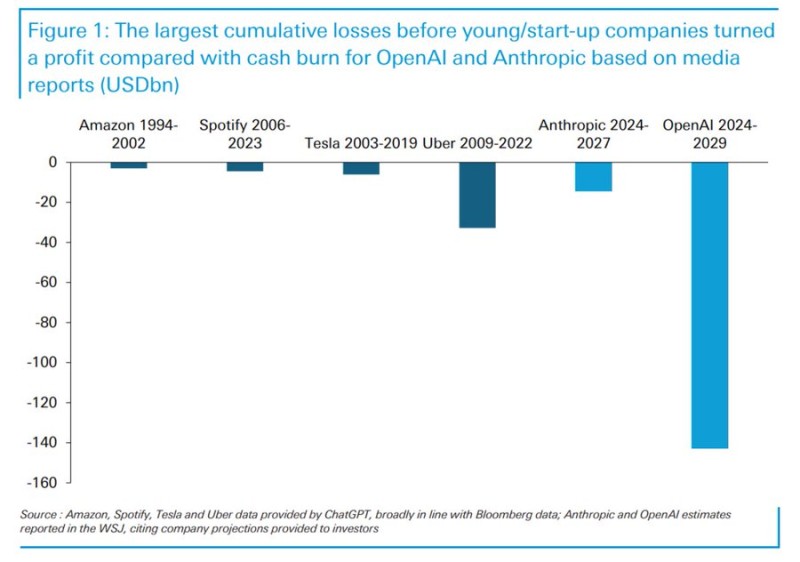
⬤ The numbers tell a compelling story. Amazon lost money from 1994 to 2002. Spotify bled cash from 2006 to 2023. Tesla operated at a loss between 2003 and 2019, while Uber did the same from 2009 to 2022. Each endured years of negative cash flow before finally crossing into profitability. But OpenAI's projected cumulative losses between 2024 and 2029 are expected to hit roughly $150 billion—a figure that towers over all of them. Even Anthropic's projected burn from 2024 to 2027, while substantial, doesn't come close to OpenAI's anticipated total.
⬤ So what's driving this unprecedented cash burn? It comes down to the unique economics of frontier AI development. Training advanced models requires massive computational resources, specialized infrastructure, and ongoing research investments that dwarf traditional software development costs. Unlike previous tech cycles where companies could scale more gradually, OpenAI is pushing the boundaries of what's technically possible in real-time—and that comes with an extraordinary price tag. The analysts acknowledge that while OpenAI might ultimately deliver breakthrough technologies that transform entire industries, the financial uncertainty surrounding its path to profitability is unlike anything we've seen before.
⬤ This comparison matters for more than just OpenAI. It's reshaping how investors think about risk in the AI sector and changing the conversation around capital deployment in high-growth tech companies. The analysis signals that frontier AI development operates on a completely different financial plane than previous technology waves, which could influence everything from competitive dynamics to regulatory approaches. For companies like Amazon and Tesla that are also investing heavily in AI, understanding these cost structures is becoming crucial to long-term market positioning.
 Peter Smith



