
 Saad Ullah
⬤ Stanford University, Princeton, and the University of Illinois have published groundbreaking research on multi-agent AI systems that changes how artificial intelligence agents work together. The paper, Latent Collaboration in Multi-Agent Systems, introduces a framework where AI agents coordinate entirely within their neural networks' latent space. Instead of relying on external messages or predetermined teamwork protocols, agents develop internal signals and collaborative behavior organically, with no explicit communication channels needed.
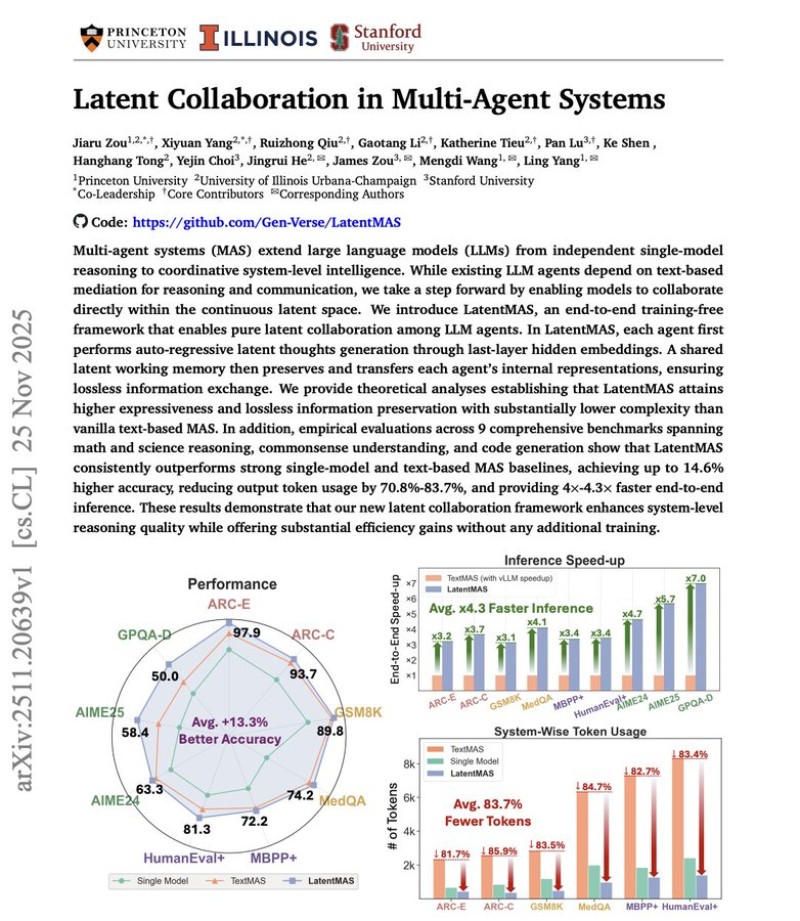
⬤ The system uses multiple large language model-based agents that generate hidden coordination cues inside their last-layer representations. Agents learn to divide tasks, shift roles, and negotiate implicitly even without any communication infrastructure. The research shows that stronger agents naturally take over roles while weaker ones step back through latent-space reinforcement, with the overall system improving through emergent teamwork. Results across math, reasoning, coding, and comprehension benchmarks revealed accuracy improvements reaching 14.6 percent over standard methods.
⬤ Beyond accuracy gains, the method delivers impressive efficiency improvements. Token usage dropped by 70 to 83 percent compared to traditional agent-based models, while inference speeds increased by an average of 3.4× and peaked at 7× on certain tasks. The approach consistently outperformed both single-agent baselines and text-based multi-agent systems without requiring additional training.
⬤ The implications stretch well beyond academic research. By demonstrating that agent teams can cooperate instinctively through learned internal representations, this work opens doors to autonomous systems that behave more fluidly and naturally. Future AI agents could adjust roles, negotiate outcomes, and coordinate strategies as environments change, without mechanical instructions or predefined messaging. This transformative path for multi-agent AI development may reshape how autonomous systems operate across robotics, software agents, and large-scale decision-making networks.
 Saad Ullah



