
 Peter Smith
⬤ Researchers from the Massachusetts Institute of Technology published a study titled "Your Brain on ChatGPT: Accumulation of Cognitive Debt when Using an AI Assistant for Essay Writing Task," which analyzed neural activity from 54 participants writing essays under three conditions: using ChatGPT, using a search engine, or writing without any digital assistance. EEG scanners tracked brain activity across multiple sessions over four months, giving the team a detailed picture of how each approach shaped cognitive engagement over time.
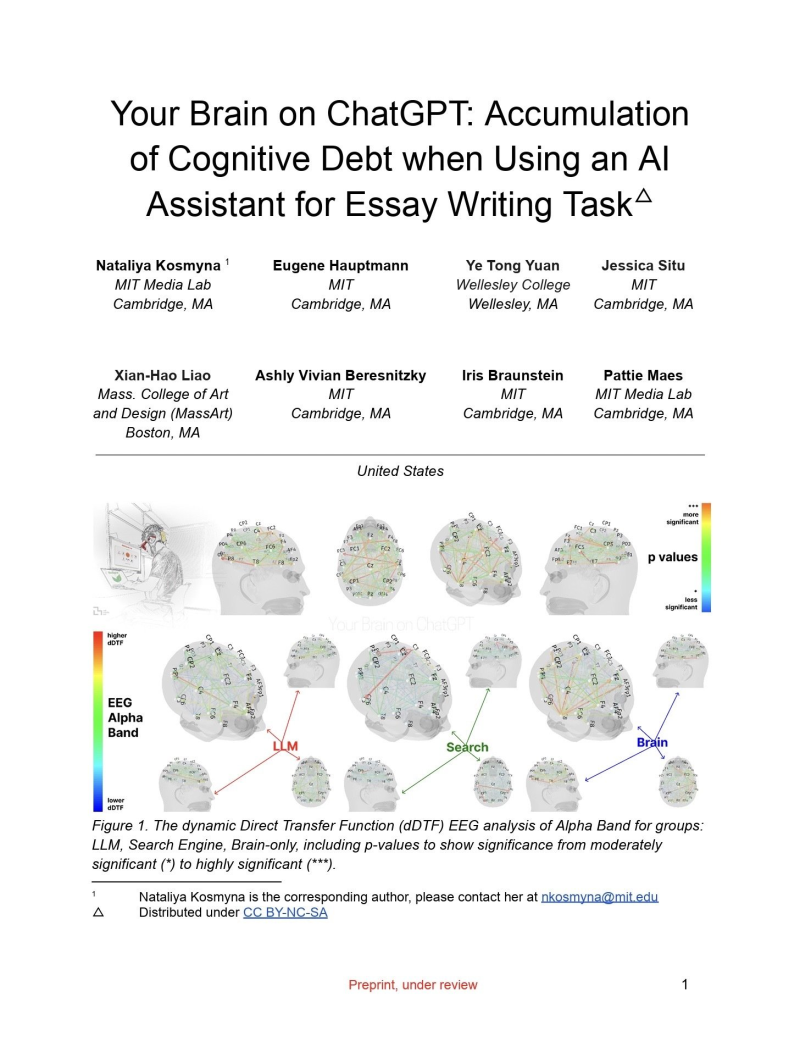
⬤ The results showed a clear gradient. Participants writing without tools demonstrated the strongest and most distributed brain network activity, while those relying on ChatGPT showed 47% reduced brain connectivity compared to the unassisted group. Search engine users landed in between, suggesting that cognitive engagement scales inversely with how much of the thinking a tool handles on the writer's behalf.
⬤ Beyond connectivity, the study recorded an 83% memory recall drop among ChatGPT users. Many struggled to accurately quote sentences from essays they had written just minutes earlier. Researchers observed that when some of those participants were later asked to write without AI support, their EEG results still showed reduced engagement in certain neural patterns compared with people who had consistently written on their own. More on how LLMs perform up to 10x worse when reading their own prior outputs has been explored in related research covering model performance and cognitive load in AI workflows.
⬤ The findings land at a moment when the AI industry is expanding at pace. Companies building large language models, along with infrastructure players such as chipmaker Nvidia, continue to benefit from the accelerating adoption of generative AI. Yet as these tools embed further into education, productivity, and knowledge work, research examining their effects on human cognition is drawing increasing attention from both researchers and the broader tech sector.
 Peter Smith



