Peter Smith
There's a strange irony buried in how modern AI chatbots work: the more they "remember" of their own previous answers, the worse they can become. A new MIT study puts hard data behind that counterintuitive observation, and the implications reach well beyond a single research paper.
MIT's "Context Pollution" Effect Explained
Researchers at the Massachusetts Institute of Technology published findings showing that large language models can actively degrade when they condition on their own earlier outputs, a pattern the team calls "context pollution." The study, titled "Do LLMs Benefit from Their Own Words?", examined multi-turn conversations and found that prior assistant responses can introduce errors, hallucinations, and stylistic artifacts, as models essentially treat their own text as ground truth.
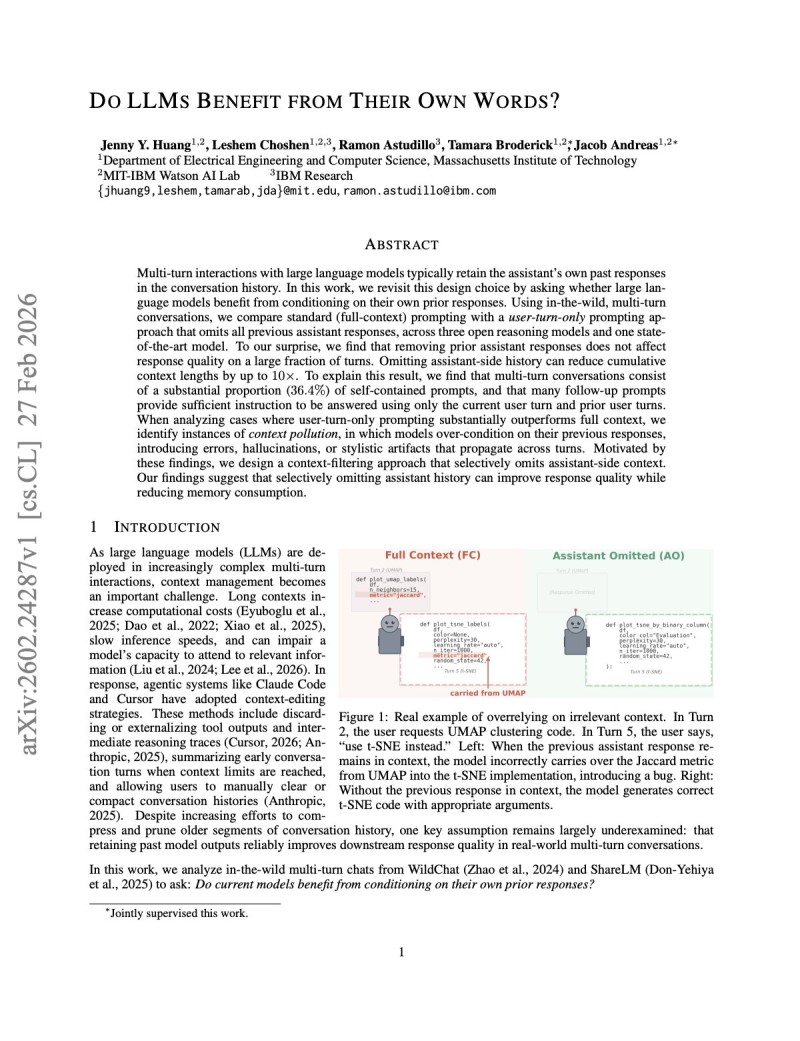
The team compared standard full-context prompting against a "user-turn-only" approach that strips out prior assistant text entirely. The result? Removing that history often had little to no negative impact on quality, and in many cases actually improved it.
A substantial portion of multi-turn exchanges are self-contained, meaning the next response can be generated using only the current user query.
One concrete example from the paper illustrates the problem clearly: an incorrect implementation detail introduced in an early turn was faithfully carried forward when full context was retained. Once that history was removed, the model produced the correct output. Bigger memory, it turns out, does not automatically mean better thinking.
Why This Changes How AI Infrastructure Gets Built
The practical stakes here are significant. By omitting assistant-side history, the researchers reduced cumulative context length by up to 10 times. That matters enormously for AI infrastructure running on NVDA GPUs and similar accelerators, where longer context windows translate directly into higher compute costs.
The finding challenges a core assumption in how many production AI systems are currently designed: that more context is almost always better. If a leaner context strategy delivers equal or superior output at a fraction of the compute cost, the entire optimization calculus shifts.
For developers, AI infrastructure teams, and anyone relying on multi-turn LLM workflows, the MIT study on LLM context pollution is worth reading closely. It raises a straightforward but underexplored question: what if the smartest thing an AI model can do is selectively forget itself?
 Peter Smith