
 Eseandre Mordi
⬤ xAI has rolled out Grok 4.20, a frontier AI model with a continuous weekly improvement cycle that uses live user data to refine performance. As tetsuo reported, Grok 4.20 introduces a multi-agent architecture - Grok acts as coordinator, Harper handles research and real-time facts, Benjamin tackles logic and code, while Lucas manages creative output - all operating in parallel and cross-validating responses. The system releases updated capability notes each week throughout its beta phase.
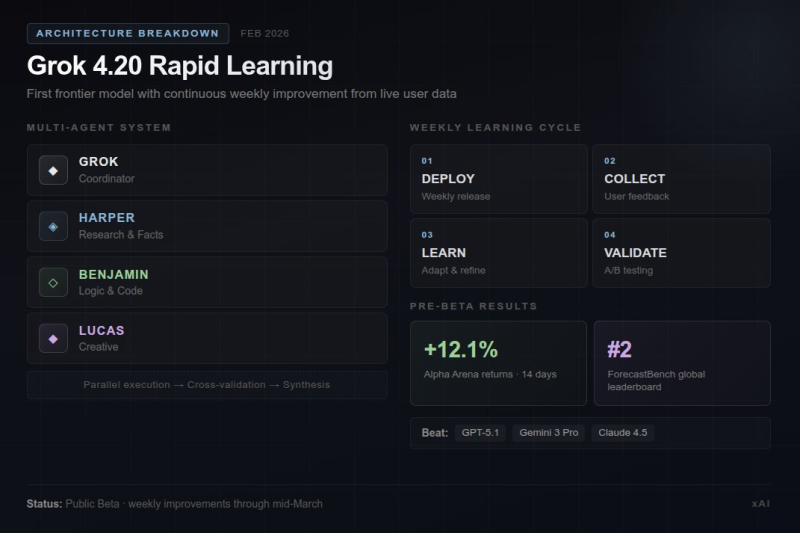
⬤ Early results show Grok 4.20 posted +12.11% aggregate returns over 14 days of live stock trading in Alpha Arena Season 1.5 (December 2025), standing out as the only profitable model in that competition. It beat leading systems like GPT-5.1 and Gemini 3. The model also ranked #2 on the ForecastBench global AI forecasting leaderboard, outperforming GPT-5, Gemini 3 Pro, and Claude Opus 4.5. These results show promising real-world performance in both prediction and trading tasks.
⬤ Elon Musk commented that Grok 4.20 will be "an order of magnitude smarter and faster" than Grok 4 by the time the beta concludes in mid-March. The weekly learning cycle includes four phases: deploy, collect, learn, and validate. Grok 4.20 gathers user feedback, adapts through iterative learning, and validates improvements via A/B testing before each release. This approach stands in contrast to typical development cycles for other major frontier models like GPT and Claude, which often take months between meaningful capability updates.
⬤ The development of Grok 4.20 occurs alongside broader shifts in AI usage and model dynamics. Usage trends have indicated changing engagement with large-scale models, as reported in Grok 4 sees 361% ROI as ChatGPT usage drops, while benchmarking reports such as Claude Opus 4.5 outperforming GPT-5.1 show shifting performance standings across the frontier landscape. These developments reflect evolving competition among AI systems in both capability and real-world applications.
 Eseandre Mordi



