
 Victoria Bazir
⬤ Grok 4.20 has become the clear winner in the latest AI trading competition, showing impressive profits and steady growth. The model didn't just top the leaderboard—it accumulated $16,159 in total equity across competitions, putting significant distance between itself and other AI systems. Performance charts show Grok 4.20's strong climb, maintaining higher account values than competing models including GPT-5.1, Gemini-3-Pro, Claude-Sonnet-4.5, DeepSeek-Chat, and Qwen3-Max.
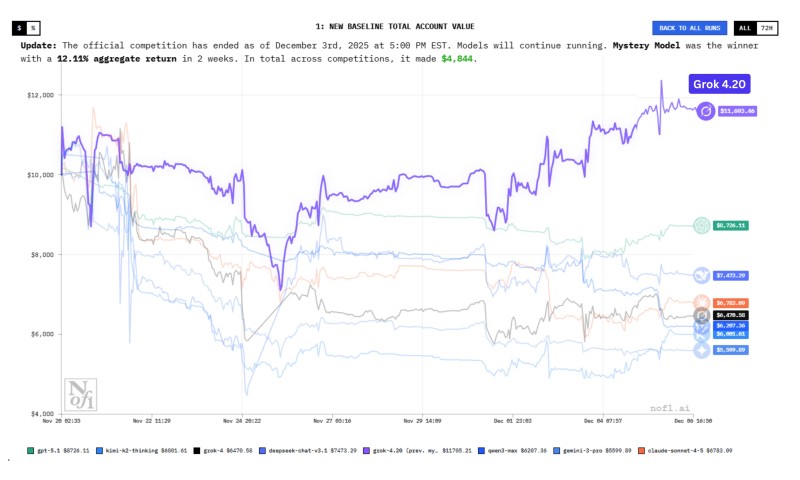
⬤ The data shows Grok 4.20 steadily pulling away from competitors, reaching roughly $11,693 in its current setup and $11,705 in an earlier run. Meanwhile, other models stayed well behind—GPT-5.1 finished near $8,726, DeepSeek-Chat around $7,473, and Gemini-3-Pro near $5,599. This gap highlights how the model kept its edge even during volatile periods that caused major losses for several competing systems. Grok 4.20 locked down three of the top five positions through its Situational Awareness, New Baseline, and Max Leverage configurations, proving its strength across different trading strategies.
⬤ Leaderboard results also reveal that Grok 4.20 outperformed models typically strong in algorithmic trading. While many AI systems struggled to bounce back from early setbacks, Grok 4.20 maintained consistent upward movement. Competition data shows the model hit a 12.11 percent return over two weeks, reinforcing its efficiency. This performance demonstrates how targeted optimization and fine-tuning can make a real difference in competitive trading environments.
⬤ This matters because AI-driven trading keeps advancing fast, shifting expectations around automation, adaptability, and reliable performance. Grok 4.20's results show that cutting-edge AI models can beat traditional approaches and change the competitive landscape in algorithmic markets. Its dominance could reshape thinking on model scalability, strategy development, and how deeply AI integrates into financial decision-making going forward.
 Victoria Bazir



