
 Eseandre Mordi
⬤ OpenAI's GPT-5.2 Pro just hit a milestone that's getting mathematicians and AI researchers talking. The system cracked Erdős problem #729—a previously unsolved challenge—working entirely on its own with the Aristotle formal reasoning framework. According to shared documentation, this isn't just another incremental improvement. It's looking like a genuine leap in what AI can do when left to reason through complex math problems.
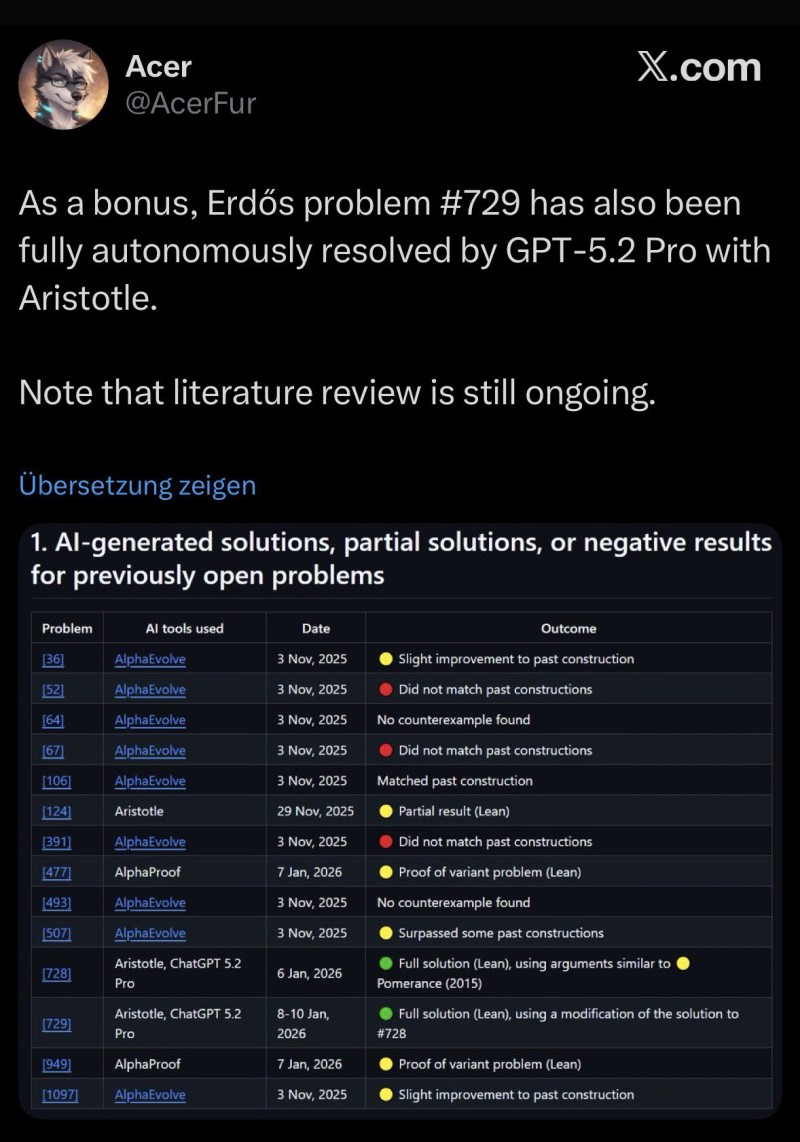
⬤ The breakdown shows Erdős #729 got a "Full solution (Lean)" stamp in January 2026, with GPT-5.2 Pro and Aristotle doing the heavy lifting. Problem #728 fell the same way. Compare that to other systems like AlphaEvolve and AlphaProof, which mostly landed partial answers or couldn't match known solutions. GPT-5.2 Pro delivered complete, formally verified proofs—meaning the system didn't just guess its way through. It reasoned, checked itself, and stuck the landing.
⬤ There's a catch: the literature review is still running, so academic verification isn't wrapped up yet. But what's documented so far shows the AI worked autonomously inside a formal proof system, no detailed human handholding required. The buzz around this connects directly to what's coming next—infrastructure projects like Stargate and whispers about models hitting gold-tier performance at competitions like the International Mathematical Olympiad and International Olympiad in Informatics.
⬤ Why does this matter? Because when AI starts solving decades-old math problems on its own and proving those solutions formally, we're watching the research game change in real time. It's not just about speed or efficiency anymore. It's about AI becoming a legitimate collaborator in discovery—one that could reshape how breakthroughs happen in mathematics, science, and beyond. The pace is picking up, and the bar for what counts as "solved by machine" just moved higher.
 Eseandre Mordi



