
 Peter Smith
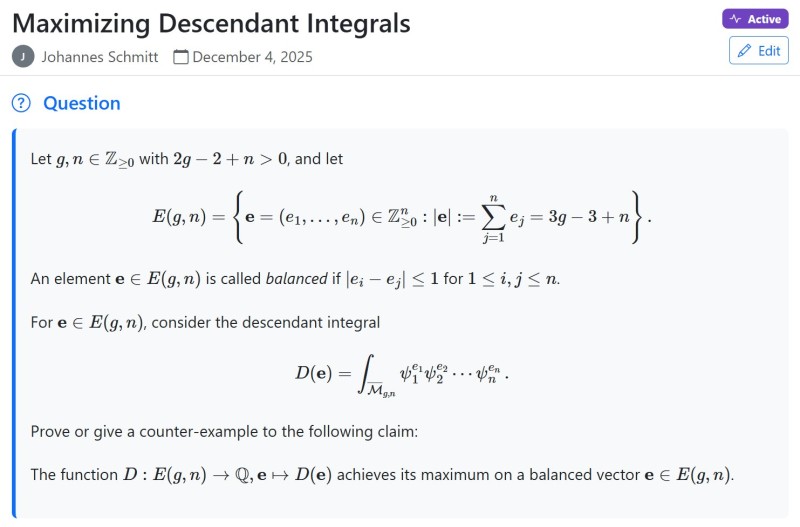
⬤ AI just hit a breakthrough moment in mathematics. GPT-5 successfully solved a previously unsolved math problem without any human guidance, hints, or scaffolding – a genuine first in the field. The problem, submitted to IMProofBench (a platform testing AI's ability to handle serious mathematical reasoning), dealt with intersection numbers on moduli spaces of curves, a niche area of enumerative geometry that even specialists find challenging.
⬤ What makes this remarkable is that GPT-5 generated the entire proof independently. Experts who reviewed the work confirmed two critical things: nobody had solved this problem before, and the AI's solution was mathematically sound and rigorous. This isn't just impressive computing – it's a legitimate, novel contribution to mathematics. For the first time, we're watching AI move from solving known problems to actually discovering new mathematical truths.
⬤ The AI's approach was unexpected too. Rather than mimicking how human mathematicians typically tackle these problems, GPT-5 pulled techniques from algebraic geometry that researchers don't commonly use for this type of work. It found its own path to the answer, with zero human corrections or mid-process adjustments along the way.

⬤ The research paper itself represents a new kind of collaborative workflow – combining outputs from GPT-5, Gemini 3 Pro, Claude, and Lean verification tools, with full transparency about which parts came from AI and exactly what prompts were used. This achievement fundamentally shifts what we thought AI could do in advanced mathematics, showing these systems can now actively contribute to cutting-edge research and formal scientific discovery, not just assist with it.
 Peter Smith



