
 Eseandre Mordi
Google's latest AI release isn't trying to be everything at once. Gemini 3.1 Flash Live has a specific target: real-time voice interaction for developers building live agents. And the benchmark numbers it's posting suggest the focus paid off.
Philipp Schmid highlighted the release, pointing to a model designed from the ground up for speed, multimodal input, and low-latency agent workflows.
Gemini 3.1 Flash Live Scores 90.8% on Audio Function-Calling, Leads Real-Time Voice Benchmarks
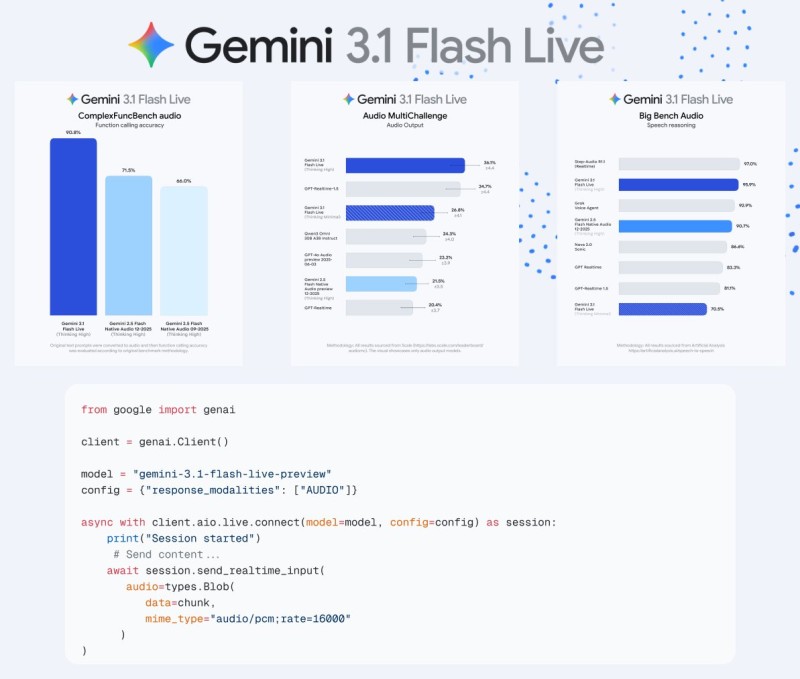
The headline number is 90.8% on ComplexFuncBench Audio, which measures function-calling accuracy in voice contexts. That's the task that matters most for agent-based applications, where the model needs to correctly interpret spoken instructions and execute the right action reliably.
Gemini 3.1 Flash Live achieves 90.8% on ComplexFuncBench Audio for function-calling accuracy, outperforming alternative models shown in the comparison chart.
Beyond that single benchmark, the model posts competitive results across audio output tasks and speech reasoning, placing it among the leading systems in real-time voice performance. These numbers fit into a broader pattern across the Gemini 3.1 family, where Google has been consistently pushing faster response times and stronger multimodal handling with each iteration.
Google's open-source ADK for always-on AI agents provides additional context here: Gemini 3.1 Flash Live isn't a standalone release but part of a coordinated infrastructure push toward persistent, live agent systems.
Gemini 3.1 Flash Live Features 128k Context Window, Video Streaming, and SynthID Watermarking
The feature set is designed for developers who need production-ready tools, not just a capable base model. The full list of what ships with Gemini 3.1 Flash Live:
- 90.8% accuracy on ComplexFuncBench Audio for function-calling
- Support for 70 languages with real-time audio transcription
- Video streaming capabilities alongside voice input
- 128k context window for extended agent sessions
- Built-in "Agent Skill" system for simplified live voice agent creation
- SynthID watermarking on all generated audio for authenticity and traceability
The SynthID watermarking is worth noting specifically. As AI-generated audio scales across applications, traceability becomes a practical requirement rather than a nice-to-have. Building it directly into the model rather than treating it as an add-on reflects where the industry is heading on authenticity standards.
GOOGL AI Push Intensifies Competition as Gemini 3 Flash Hits 90.4% on GPQA Diamond
The competitive context is relevant for GOOGL investors. GPT-5.4 Mini recently scored 72.1% on OSWorld while Gemini 3 Flash hit 90.4% on GPQA Diamond, showing that the benchmark race across the major AI labs is tightening on some dimensions while Google pulls ahead on others. Real-time voice and agent tooling is clearly one of the areas Google is choosing to lead.
For GOOGL, the release reinforces a consistent pattern: rather than competing purely on general reasoning benchmarks, Google is building out the infrastructure layer for live, interactive AI deployment. Gemini 3.1 Flash Live is a specific bet that real-time voice agents become a major deployment category, and the 90.8% function-calling accuracy is the technical argument that it's ready to handle that role.
 Eseandre Mordi



